There's something you're carrying into every meeting.
Maybe it's frustration from a conversation that went sideways weeks ago. Maybe it's resentment toward someone who still hasn't acknowledged what happened. Maybe it's doubt about whether you're even in the right role anymore.
You thought you'd moved past it. But it's still there — in how you hold back, how you react, how you brace yourself before certain people or conversations.
It's not the meeting. It's what you're dragging into it.
And here's the thing most people don't realise: the emotions you carry into a room don't stay with you. They spread.
Research on emotional contagion shows that people "catch" feelings from others. Your frustration becomes the team's tension. Your doubt becomes the room's hesitation. What you're holding onto quietly shapes the culture around you — whether you mean it to or not.
Every organisation has an emotional culture, even if it's one of suppression.
So dealing with what you're carrying isn't ...
Today we kicked off something a little different for riders&elephants. We launched a 12-month partnership with She Is Unleashed — a women-in-business community that runs weekly networking groups across Aotearoa New Zealand.
On the surface, you might wonder: why would an emotional culture company partner with a women's networking organisation? Where's the overlap between ECD facilitation and business networking events?
The answer, it turns out, is almost everything.
She Is Unleashed was founded by Kim Brown after she returned to New Zealand from Australia, building a business but craving something deeper than surface-level networking. She wanted a space where women could be genuinely seen, supported, and safe to grow — both personally and professionally.
What started as that search for real connection has grown into a community of women across New Zealand, with networki...
There's a conversation you've been avoiding.
You know the one. It sits in your chest. You rehearse it in the shower. You almost bring it up — then don't.
Maybe it's with someone you lead. Maybe it's with your boss. Maybe it's with someone you love.
The words are there. But something's missing.
Here's what I've learned: the barrier to difficult conversations isn't usually what to say. It's how we need to feel before we can say it.
Confident enough. Safe enough. Brave enough. Clear enough.
Until we feel those things, the conversation stays stuck.
This week's Beautiful Question:
What do you need to feel more of to be able to have this difficult conversation?
It's a question worth sitting with.
Not "what should I say?" — but "what do I need to feel first?"
Because when you know that, you can start building toward it. And the conversation that felt impossible starts to feel possible.

A simple exercise:
Think about a conversation you've been putting off.
Now ask yoursel...
Whether you're starting a new role, leaving a job, welcoming a child, navigating a restructure, or facing something you didn't expect — transitions are emotional.
You're not who you were. But you're not yet who you're becoming.
That in-between space is uncomfortable. And most of us try to rush through it, suppressing or ignoring the emotions, and instead focus on the rational side of change: logistics, plans, process.
All the while, our emotional response dictates how we actually navigate the shift.
My wife Becky and I struggled for four years with infertility. We eventually had our first baby, Izzy, on our third & last round of IVF.
We went from the despair of thinking we would never have children — to having three babies under 2.5 years old.
I designed the ECD Transitions Handbook to help Becky and myself navigate these life-changing transitions we went through over that period.
It's incre...
Most change programmes focus on strategy, process, and communication.
They forget the one thing that determines whether change actually sticks: how people feel.
In 2024, we ran a pilot programme with one team inside a New Zealand government agency — and partnered with Professor Michael Parke from Wharton Business School to measure what happened when you put emotions at the centre of a change programme.
The context
The agency was going through a high-stakes consultation affecting thousands of employees. The kind of change that typically triggers anxiety, disengagement, and burnout.
Instead of following a traditional change playbook, one leadership team tried something different. They used our Emotional Change Programme to help their people name how they were feeling, have honest conversations, and design emotionally intelligent ways of working through the uncertainty together.
What we measured
Working with Professor Parke, we tracked employee engagement, emotional awareness, lead...
A year’s worth of emotional culture conversations across 49 countries, experiments, courage, learning, doubt, progress, and care. Across different countries, industries, organisations, and rooms. All sitting alongside each other.
→ Click here to read full screen version on your phone or desktop: https://ecdeck.com/fworld-2025
There are so many more stories we could have included. If we tried to fit everything our community shared in 2025, this would easily be a 500-page document. Choosing what to include was hard — not because there wasn’t enough, but because there was so much.
This edition captures what 2025 actually felt like!
People trying things for the first time. Major shifts across teams, organisations, and whole businesses. Emotions being named that had been sitting under the surface for a long time. Leaders creating space to really listen. Small rituals that quietly changed how work felt day to day. And works...
We often talk about feedback as if it’s rational, neutral, and technical. This research shows that’s a myth.
Feedback is saturated with feeling. Not just how feedback is received, but how it is given, judged, remembered, and acted on. Emotions aren’t background noise. They're doing the work.
The authors observed real feedback moments in high-pressure medical settings (ICU and surgery). They watched. They listened. They traced what feelings did over time.
Not just what people said but:
body language
tone
silences
what lingered
what people avoided later
This is called focused ethnography, grounded in modern emotion theory.
Performance judgements are felt, no...
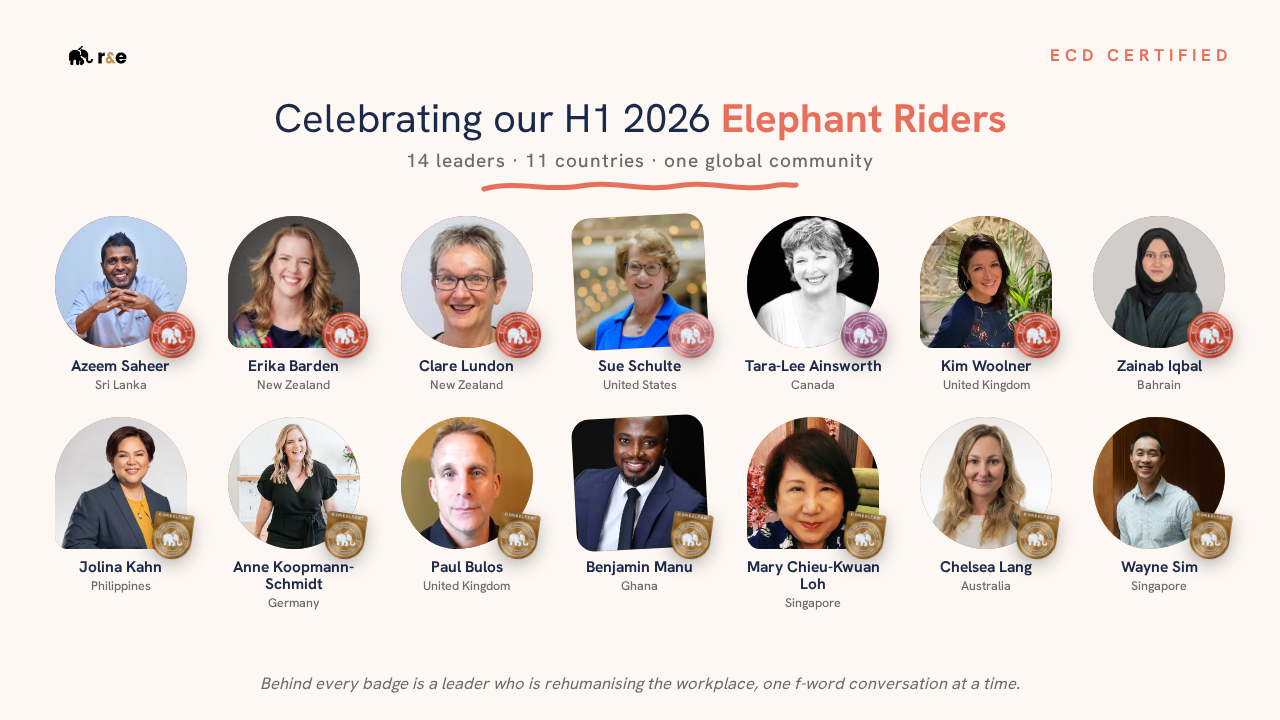
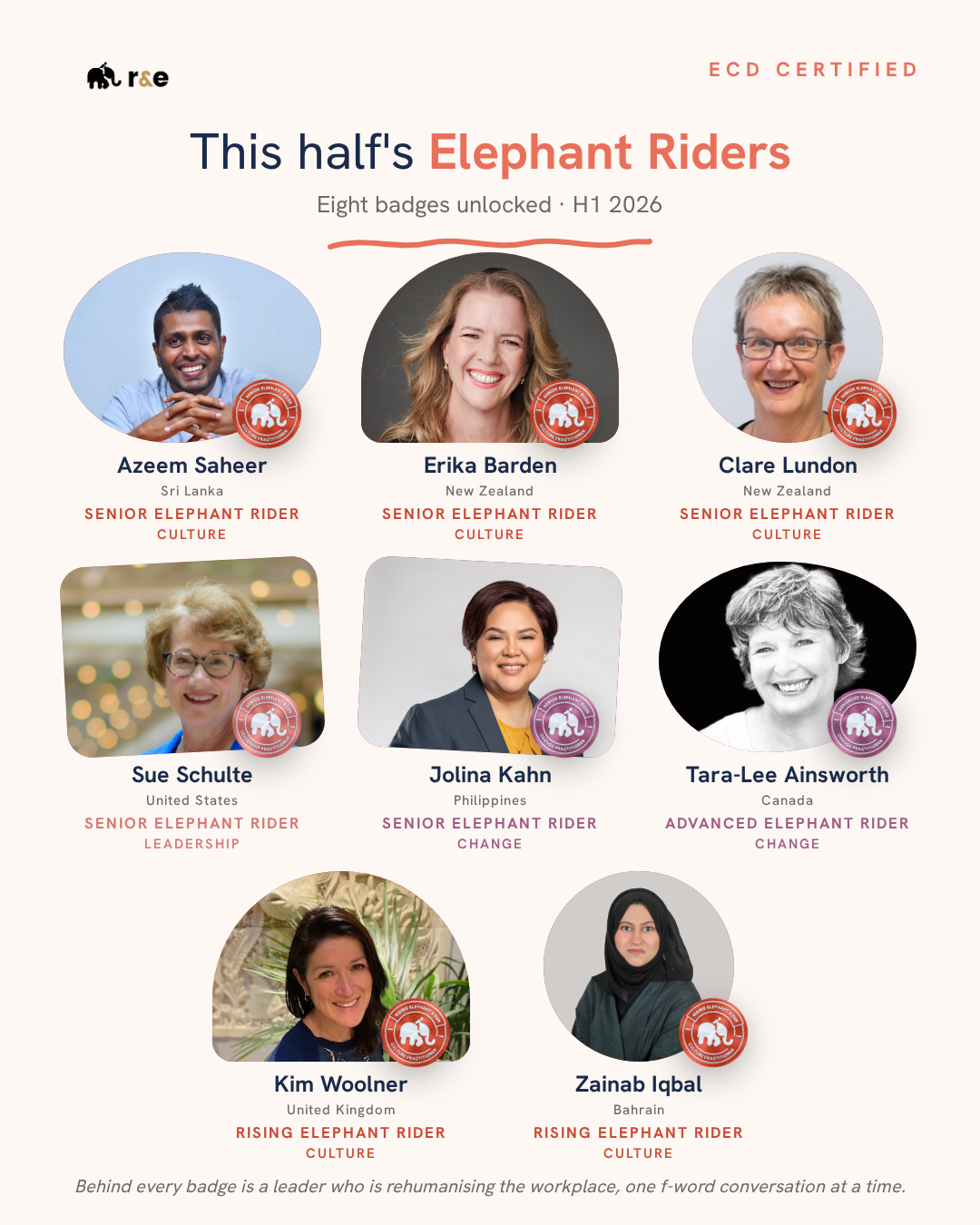
Today we celebrate seven remarkable human-centred leaders who have completed the 12-month Emotional Culture Deck Certified Consultant Development Programme:
Each of them brought something unique. Each of them stretched themselves.
Each of them leaves with a deeper, deeper understanding of how emotional culture shapes performance, leadership and human connection.
Here are some of the insights from their journey, in their own words.
Shae Beswick – “Emotions are not the soft stuff. They’re a strategic driver of culture, performance and behaviour.”Â
Cara Cunniff – “Once people have language for their emotional world, clarity, honesty an...
Last week, inside our Elephant Rider Community, we hosted an inspiring Elephant Rider Showcase featuring Chelsea Lang (Certified Consultant in Training) and Danii Garrett (Emotional Culture Practitioner).
In this brave and deeply human conversation, Chelsea and Danii walked us through the Reset & Elevate programme they designed, delivered, and refined over the past year — a bold emotional culture transformation at Sanitarium that has achieved extraordinary outcomes.
They shared how they brought The Emotional Culture Deck to life at scale, from designing the programme to rolling it out across teams, navigating challenges, and learning from every step along the way.
What unfolded is a story of courage, data, and deep human connection. One that shows how The Emotional Culture Deck can turn conversation into measurable change.
It was timely reminder that when culture work gets hard, it’s often because we’ve forgotten one simple truth: every transformation begins with emotion.Â
That’s ...
I was delighted to take my maiden voyage with the deck on July 9th. The audience was a group of facilitators for an auto manufacturer that has been struggling with gender and generational bias. Their leadership affectionately described them to me as an “Old Boys Club full of cranky old white dudes (and one unbelievably forgiving woman) who think they know everything and don’t know when they are being #$sholes.” I had 3.5 hours to help them develop their emotional intelligence around anyone not white, male and over 60. I kicked the conversation off with the ECD.
My ice breaker was the familiar, “When you think about the last 48 hours what 5-6 emotions most accurately describe how you are feeling?” No surprise, the woman was able to make her selections in about 5 minutes, most of the men found their way to the 10 minute mark, and 2 struggled all the way to the finish line at about 15 minutes. Befo
...
50% Complete
Lorem ipsum dolor sit amet, consectetur adipiscing elit, sed do eiusmod tempor incididunt ut labore et dolore magna aliqua.