
New findings: Why emotions are the missing piece in change
Most change programmes focus on strategy, process, and communication.
They forget the one thing that determines whether change actually sticks: how people feel.
In 2024, we ran a pilot programme with one team inside a New Zealand government agency — and partnered with Professor Michael Parke from Wharton Business School to measure what happened when you put emotions at the centre of a change programme.
The context
The agency was going through a high-stakes consultation affecting thousands of employees. The kind of change that typically triggers anxiety, disengagement, and burnout.
Instead of following a traditional change playbook, one leadership team tried something different. They used our Emotional Change Programme to help their people name how they were feeling, have honest conversations, and design emotionally intelligent ways of working through the uncertainty together.
What we measured
Working with Professor Parke, we tracked employee engagement, emotional awareness, leader support, and burnout over 6 weeks — before, during, and after the programme.
What we found
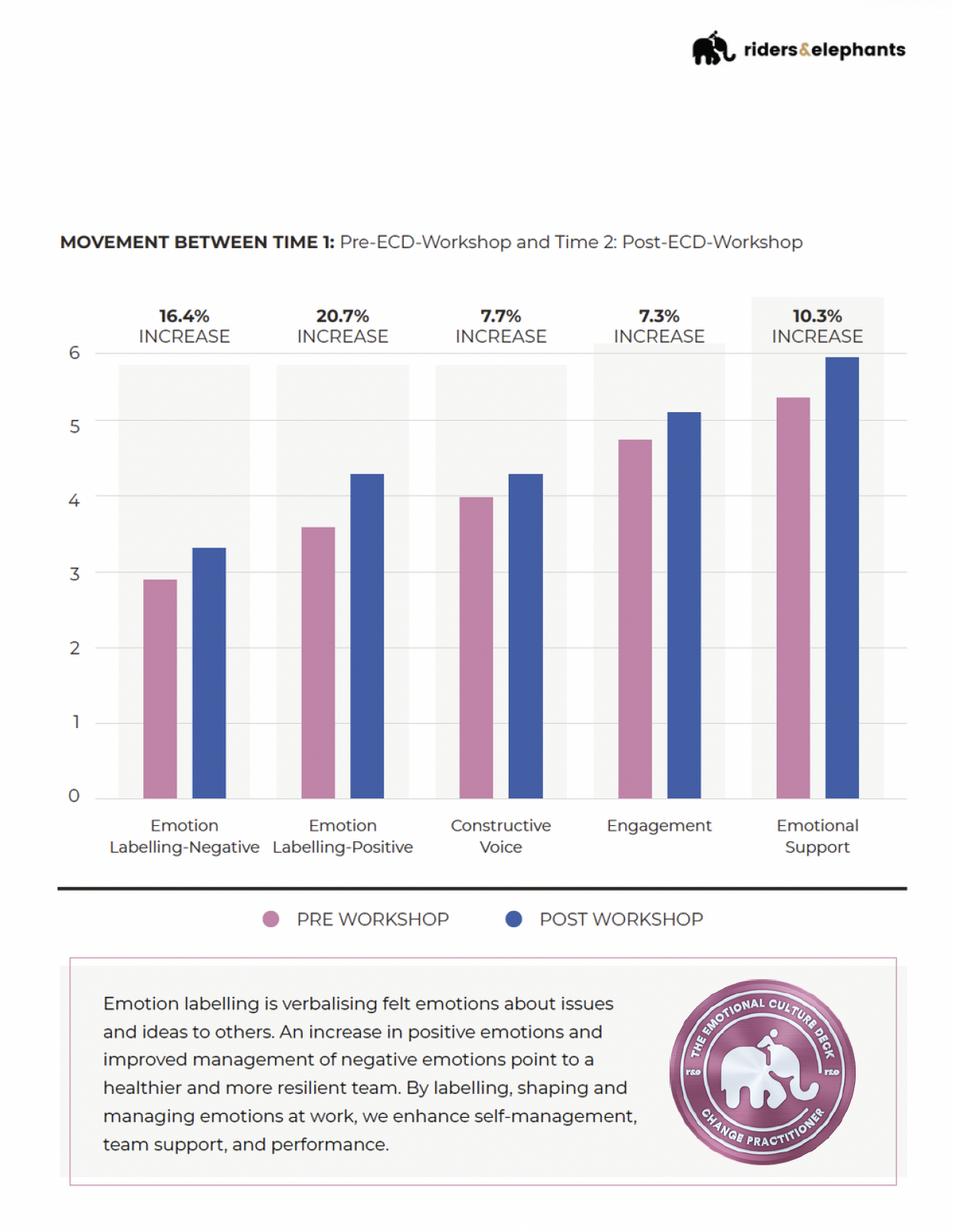
The early results were encouraging:
- Employee engagement increased by 7.3% — during a period when it typically drops
- Positive emotion labeling improved by 20.7% — people got better at naming what they needed to feel
- Negative emotion labeling improved by 16.4% — people got better at naming what was hard
- Emotional support from leaders increased by 10.3% — teams felt more supported
- Burnout didn't increase — despite the intensity of the change
That last one matters. Organisational change is one of the leading causes of workplace burnout. The fact that this programme held the line — while improving engagement and emotional awareness — is a signal worth paying attention to.
Why it works
The findings point to a concept called affect labeling — the simple act of putting feelings into words. Neuroscience shows that when we name an emotion, we reduce its intensity and regain the ability to think clearly. It moves us from reactive to responsive.
But here's the key: it's not enough to feel your feelings privately. The real shift happens when teams create shared language and shared rituals around emotion. When leaders ask "how do we need to feel to get through this well?" — and actually listen to the answers.
That's what emotional change leadership looks like. Not soft. Strategic.
What this means for you
If you're leading people through change right now, the early evidence is clear:
Emotions aren't a distraction from the work or the transformation. They are the work that drives (or blocks) the transformation.
The teams that figure this out won't just survive change. They'll come out stronger.
This pilot was conducted in partnership with Professor Michael Parke, Wharton Business School. We're continuing to explore and measure the impact of emotional culture on change outcomes.
Want to go deeper?
Download the full white paper — free. It explores how emotional rituals, psychological safety, and leader support create change people believe in.
