
What You're Dragging Into Every Meeting
There's something you're carrying into every meeting.
Maybe it's frustration from a conversation that went sideways weeks ago. Maybe it's resentment toward someone who still hasn't acknowledged what happened. Maybe it's doubt about whether you're even in the right role anymore.
You thought you'd moved past it. But it's still there — in how you hold back, how you react, how you brace yourself before certain people or conversations.
It's not the meeting. It's what you're dragging into it.
And here's the thing most people don't realise: the emotions you carry into a room don't stay with you. They spread.
Research on emotional contagion shows that people "catch" feelings from others. Your frustration becomes the team's tension. Your doubt becomes the room's hesitation. What you're holding onto quietly shapes the culture around you — whether you mean it to or not.
Every organisation has an emotional culture, even if it's one of suppression.
So dealing with what you're carrying isn't just for you. It's for everyone around you.
This week's Beautiful Question
Which emotions do you need to let go of to move forward?
Not "what should you stop feeling?" — but which emotions have done their job, delivered their message, and are now just weighing you down and affecting how you show up with others?
A simple exercise
Think about the last few weeks at work.
- What situation, person, or moment are you still thinking about more than you'd like?
- Select 3-5 emotion cards that capture what you're feeling about it.
- Where is it showing up — at home, in other relationships, in how you're leading?
- What will you do with it — have the conversation, make the decision, or accept it and stop carrying it with you?
Sometimes naming it is enough to stop it from spreading — to your team, your family, your next decision.
What the research says
Professors Sigal Barsade and Olivia O'Neill spent a decade studying emotional culture in organisations. One of their key findings:
"Negative emotions such as group anger, sadness, fear, and the like usually lead to negative outcomes, including poor performance and high turnover."
But here's what's often missed: emotional culture isn't just shaped by leaders or policies. It's shaped by what every person carries into the room, every day.
The emotions you hold onto don't just affect you. They ripple outward — into your team, your meetings, your relationships at work.
Dealing with what you're carrying isn't selfish. It's one of the most generous things you can do for the people around you.
A free culture conversation tool for you
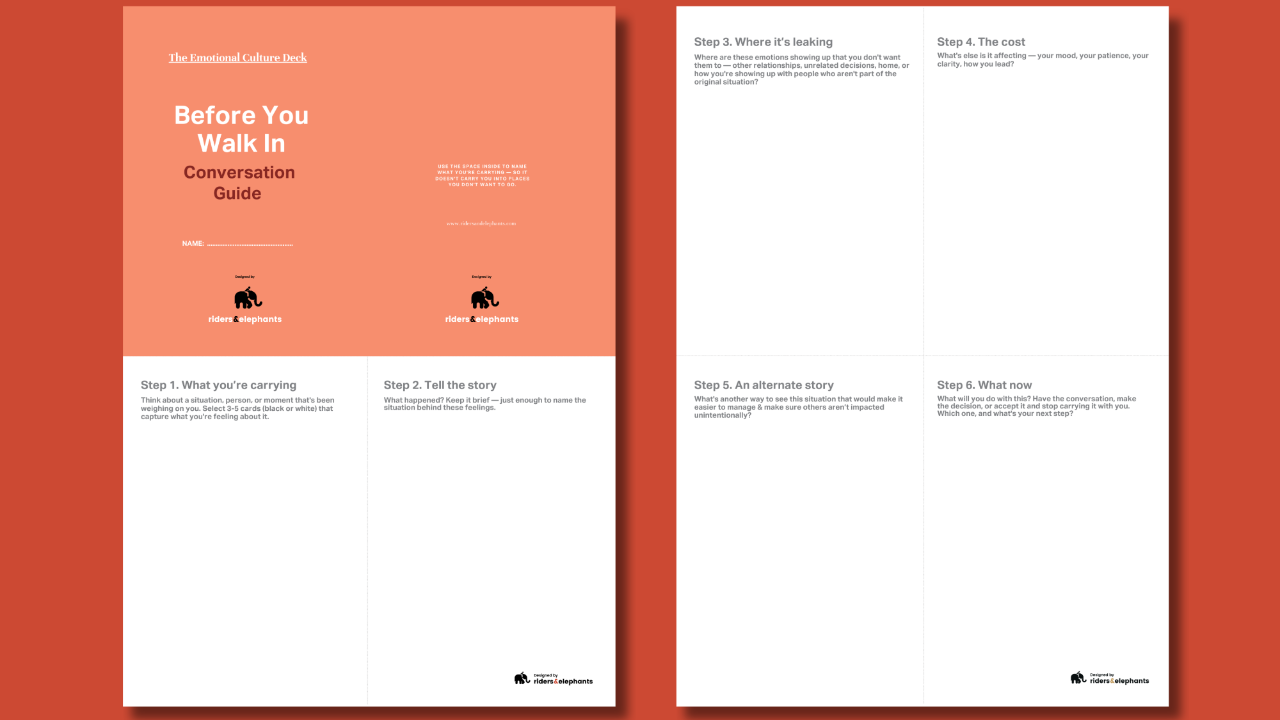
I've created a simple one-page guide to help you name what you're carrying — before it leaks into your next meeting, your relationships, or your evening at home.
Use it:
- Before a team meeting
- Before a 1:1
- Before a difficult conversation
- Before you get home
Because what you carry doesn't just affect you — it shapes how everyone around you experiences you.
Download the Before You Walk In Conversation Guide →
Don't have The Emotional Culture Deck yet? Download the free ECD PDF here → — it complements every tool we design, share, and teach.
From our community
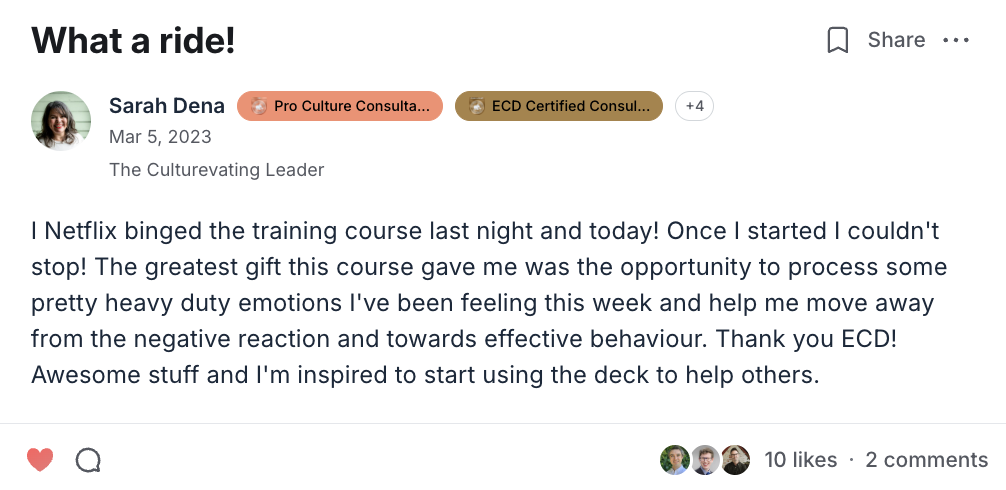
Sarah Dena described what happened when she took time to process what she was carrying:
"The greatest gift was the opportunity to process some pretty heavy duty emotions I've been feeling this week and help me move away from the negative reaction and towards effective behaviour."
That's what this tool is for — naming what you're carrying so it doesn't dictate how you show up.
The emotions you're carrying don't just weigh you down. They shape the culture around you.
