
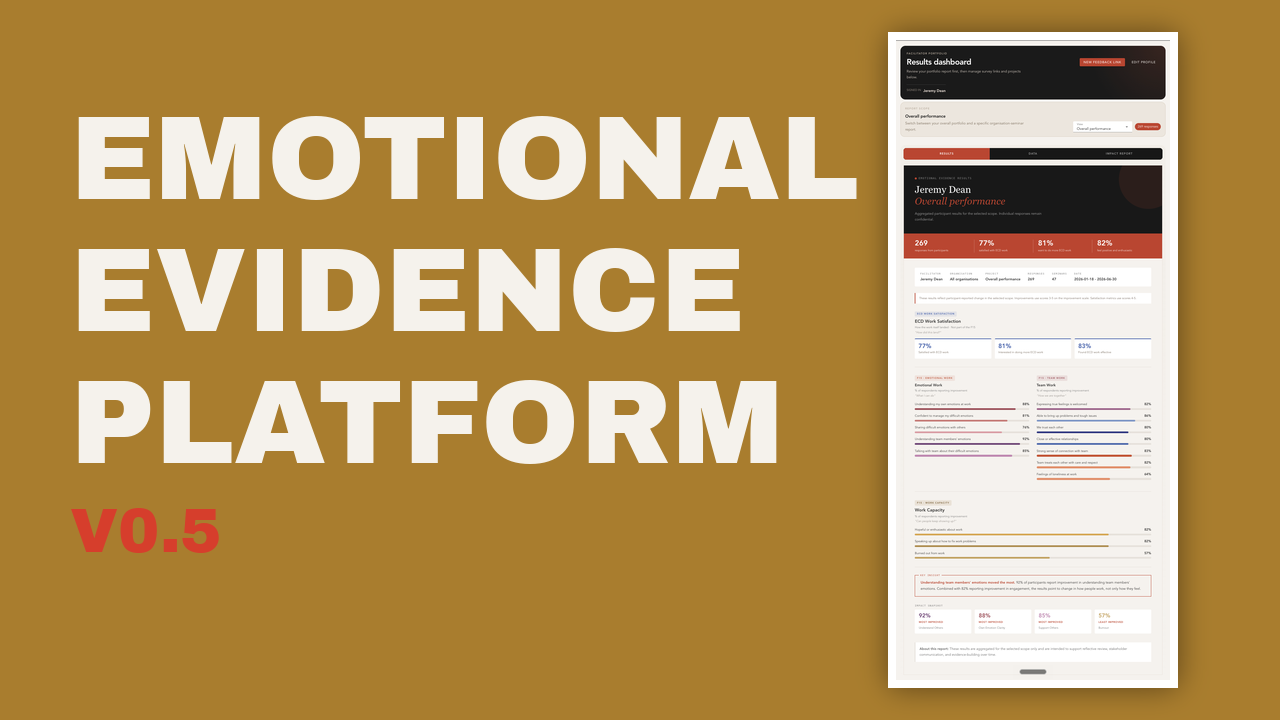
269 people. 4,554 data points. We're building the evidence base for the thing most leaders say can't be measured
"You can't measure that." I've heard some version of that sentence for eight years. Emotions are too soft, too subjective, too fuzzy to count. There's no ROI on a conversation about how people feel. Do the culture workshop if you must, but don't pretend you'll ever prove it did anything.
I've stopped arguing with that sentence. We're answering it with evidence instead. And I want to show you that evidence while it's still being built, not after it's polished.
Where it started
For almost 9 years now, The Emotional Culture Deck has helped leaders and teams around the world have the conversations most workplaces avoid. Conversations about how people actually feel at work, and how they want to feel. We could see the work landing in the room. People could feel it. And the person who signs the invoice was still being asked to take it on faith. So at the start of this year we quietly began building the Emotional Evidence Platform. One QR code, one short survey, and the impact of emotional ...
HBR Paywalled the Article That Sparked The ECD, So We Wrote Our Own
The article that sparked a global movement is now behind a paywall. So we wrote our own.
Every workplace has an emotional culture
It's the unspoken norms about which emotions are encouraged, tolerated, or suppressed. It shapes how people show up, how they collaborate, and how they perform under pressure.
Most organisations focus on cognitive culture — values, beliefs, and ways of working. But emotional culture is just as powerful. It's what people feel when they're at work, and it influences everything from engagement to innovation to wellbeing.
The problem? Most leaders don't know how to see it, name it, or shape it.
Where this work began
In 2016, Sigal Barsade and Olivia O'Neill published "Manage Your Emotional Culture" in the Harvard Business Review. It was a landmark piece — the first time emotional culture had been named and framed as something leaders could actively design.
That article sparked everything we do at riders&elephants.
We originally designed The Emotional...
Emotion Science Simplified: Why Emotion at Work Is Messier (and More Political) Than You Think

Exploring Emotion Science. Numbers v Narratives.
Most emotion research at work falls into two camps. One counts emotions. The other listens to stories. And according to Stephen Fineman, only one of these truly captures the messy, human reality of how we feel at work.
In his paper “Appreciating Emotion at Work: Paradigm Tensions,” Fineman critiques the over-simplification of emotion in organisational science. He makes a passionate case for moving beyond tidy surveys and into the rich, political, uncomfortable truth of workplace emotion.
Two Ways to Study Emotion at Work
Fineman defines a key tension:
-
Essentialist approach: Emotions are seen as internal states inside individuals. Researchers try to measure them like any other variable through surveys, tests, and scores. This is where emotional intelligence and positive psychology usually sit.
-
Interpretivist approach: Emotions are shaped by the world around us, our culture, relationships, language, and power dynamics. Resea
...
I Used to Call It a Game. Here’s Why That’s No Longer Enough.
Why We’re Shifting the Language
When I first launched The Emotional Culture Deck back in 2017, I called it a tool. A game, even. Something that helped people discuss their feelings at work in a way that felt human, not forced.
And it worked. The simplicity of the deck helped teams open up. It got leaders listening. It made emotion a safe thing to talk about.
But over the years, something bigger happened.
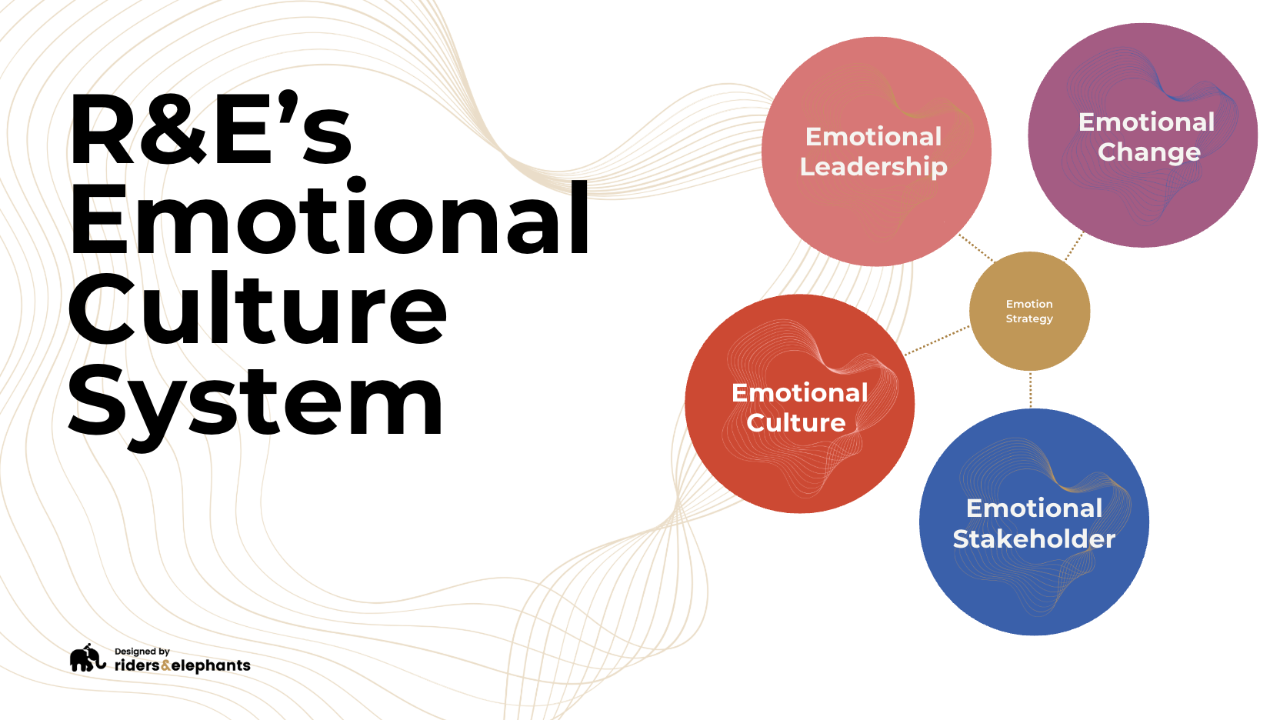
People started using it again. And again. They built rituals around it. They used it to design culture. To lead teams. To manage change. To reshape stakeholder experiences.
They weren’t just playing a game. They were working a system.
Why It Matters Now
The more this work has spread, the clearer the pattern became.
The people creating real, lasting impact weren’t just using the deck as a one-off tool. They were using it to embed new ways of relating, leading, and designing how people feel at work.
The Emotional Culture Deck has gone beyond a deck of cards. It's still at the ...
Flipping Customer Experience: How Mel Howell Transformed Culture at BurgerFuel

What does it take to create an unforgettable customer experience?
For BurgerFuel, it wasn’t just about great food—it was about how customers feel the moment they step into a store. Leading this transformation was ECD Practitioner Mel Howell, who designed and delivered the largest-ever hybrid project for the Customer Experience & Emotional Culture Deck in the world.
In 2020, Mel launched a game-changing customer and employee experience programme across 50+ BurgerFuel stores in New Zealand. Her approach blended The Emotional Culture Deck with the Customer Experience Deck, helping store leaders design unique in-store cultures that drive customer engagement, employee satisfaction, and business success.
The Challenge: Creating Consistent Yet Unique Customer Experiences
Post-COVID, BurgerFuel recognised that customer experience would be the key differentiator in a competitive hospitality market. But how do you create a customer experience that feels authentic, not scripted? And how do...

