
269 people. 4,554 data points. We're building the evidence base for the thing most leaders say can't be measured
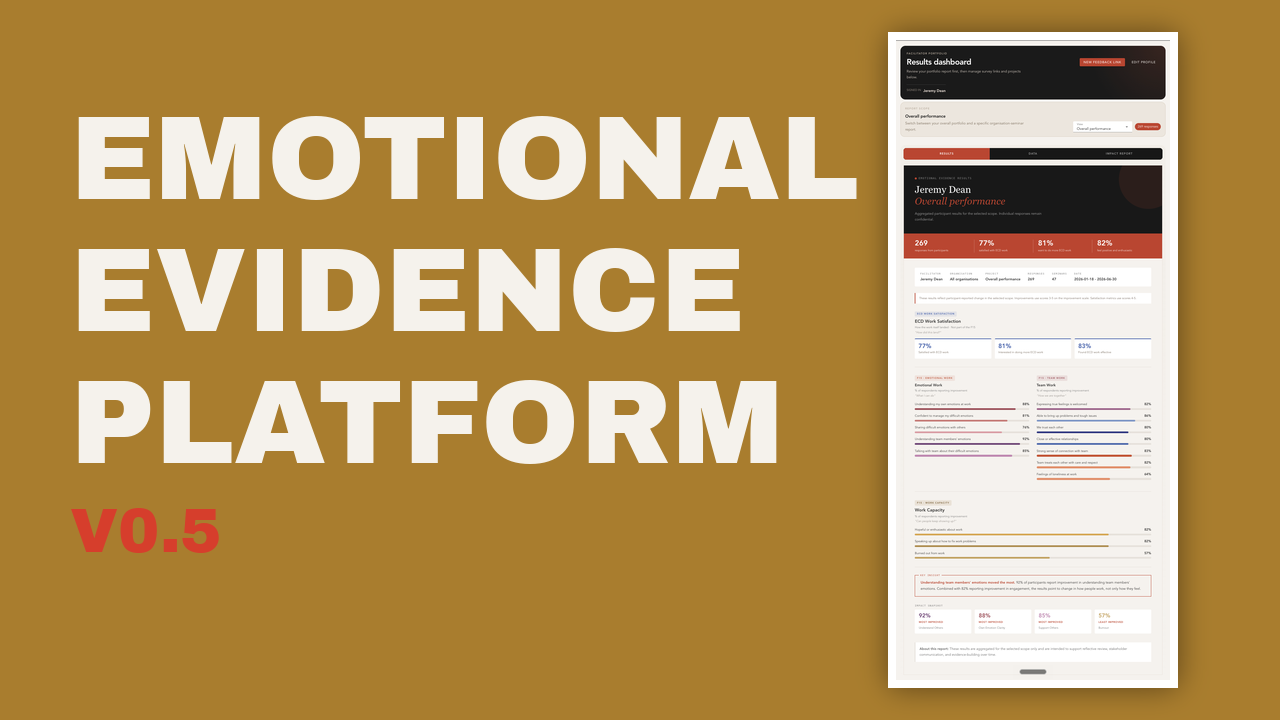
"You can't measure that." I've heard some version of that sentence for eight years. Emotions are too soft, too subjective, too fuzzy to count. There's no ROI on a conversation about how people feel. Do the culture workshop if you must, but don't pretend you'll ever prove it did anything.
I've stopped arguing with that sentence. We're answering it with evidence instead. And I want to show you that evidence while it's still being built, not after it's polished.
Where it started
For almost 9 years now, The Emotional Culture Deck has helped leaders and teams around the world have the conversations most workplaces avoid. Conversations about how people actually feel at work, and how they want to feel. We could see the work landing in the room. People could feel it. And the person who signs the invoice was still being asked to take it on faith. So at the start of this year we quietly began building the Emotional Evidence Platform. One QR code, one short survey, and the impact of emotional culture work becomes something you can hold up. Built alongside our research partnership with Professor Michael Parke at Wharton, and designed around one principle we will not trade away: behind every data point is a human being, and no individual is ever exposed.
What's being collected, right now
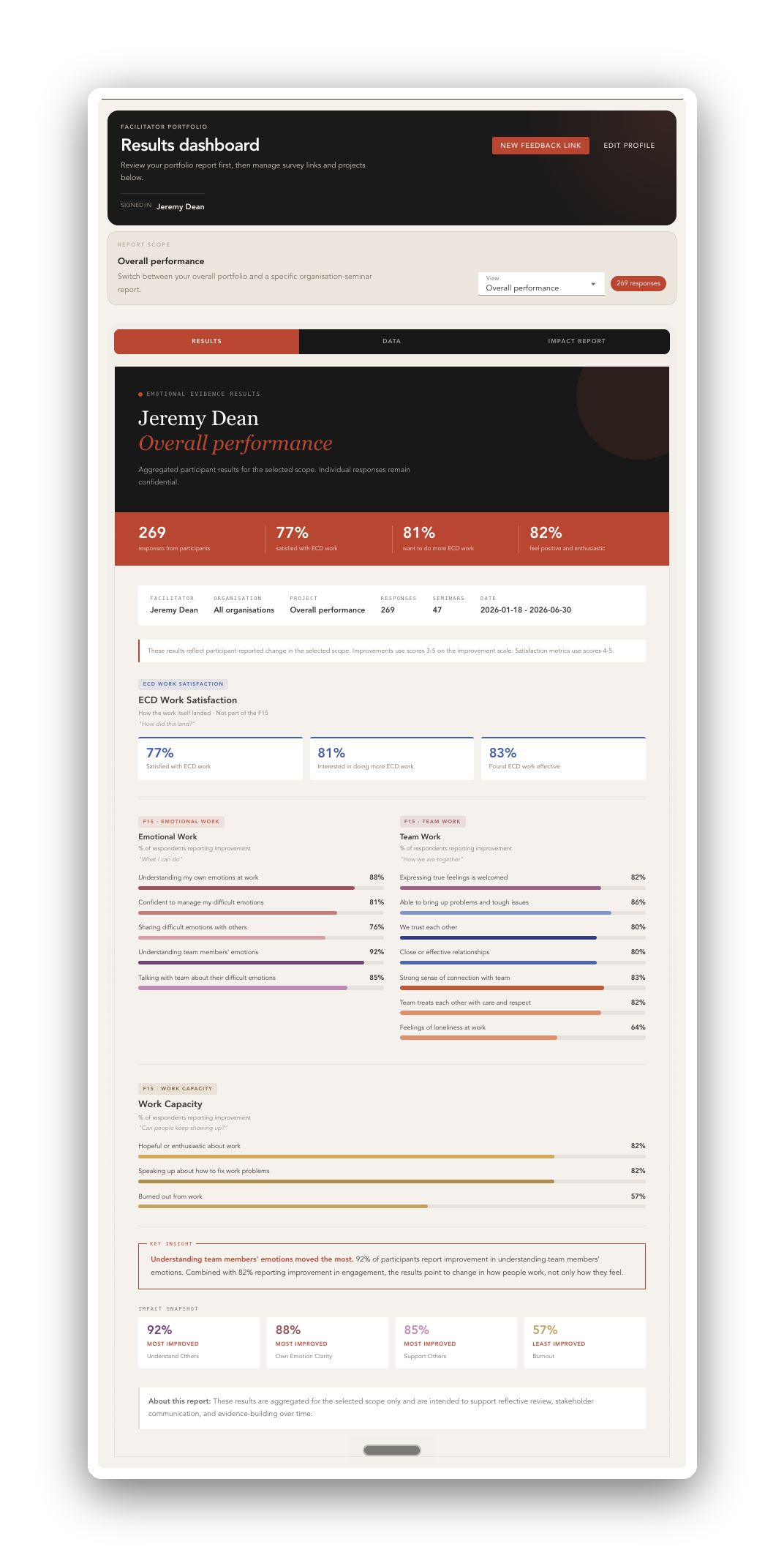
This month we counted properly for the first time, and here is where the counter stands. 269 people, across 47 engagements, whether programmes, workshops or one-to-ones, in organisations across multiple countries, have told us how emotional culture work landed for them. That's more than 4,500 individual data points on psychological safety, trust, connection, loneliness, burnout, voice and more, collected in four months, from real teams doing real work. Not a lab. Not a one-off engagement survey. A growing, living evidence base that gets bigger every single week, every time a facilitator somewhere in the world finishes a session and someone scans a QR code. By the time you read this, the number is already out of date. That's the point.
And as far as I know, nobody else in the world is doing this. Plenty of platforms measure workplace sentiment. Nobody else is deliberately moving the emotions that drive performance and measuring what shifts because of it, at this scale, across this many teams, in partnership with researchers at one of the world's leading business schools.
One thing to be clear about
We're not measuring people's individual emotions. We're measuring what moves because of the emotional culture conversations teams are having. The conversations are the work. The data is the evidence of what they shift.
What the first count shows
The work lands from the inside out. The strongest reported improvement is in understanding other people's emotions, where 92% of respondents report improvement, and understanding your own, at 88%. The team layer follows close behind. Raising tough issues, connection, psychological safety and trust all sit around the 80s. And then the numbers soften exactly where you would expect them to if people were being straight with us. Sharing your own difficult emotions sits at 76%, loneliness at 64%, and burnout, the hardest thing in working life to shift, at 57%.
I feel that is one of the most revealing things on this page. If every number said 90%, you wouldn't believe it, and neither would I. People are telling us this work quickly changes how they see and understand emotion, and that the heavier outcomes take longer. That is exactly how humans work. These are self-reported improvement scores from people who chose to respond, so we say "people tell us" rather than "the deck causes". We never report a group smaller than three, we never surface an individual, and when a number looks bad it goes in anyway. Honesty is the credibility.
Why it matters
Every organisation on earth runs on emotions. They drive decisions, effort, trust, loyalty, and whether someone speaks up about the problem that becomes next year's crisis. Yet most organisations still treat emotions as noise rather than signal, unmeasurable and therefore unmanageable. Our ultimate goal is to prove the currency of emotions. To show, with evidence gathered from real teams at real scale, that when you deliberately move emotions, performance moves with them. The leaders who told me it isn't possible, or isn't worthwhile, or has no ROI weren't bad leaders. They just had no evidence either way. Now the evidence is being built, in public, one team at a time.
Watch it grow & evolve
The platform is in invited early-user testing with our community of Certified pPractitioners & Partners through to early 2027, and I'll keep publishing the count as it climbs, including the numbers that don't flatter us. 269 people today. Watch what that number becomes. And if you're a leader who has ever said "you can't measure that", or you're curious what the emotions in your team are quietly costing or creating, that conversation is exactly where this work begins.
P.S. Alongside the platform, we're also running formal academic research with Professor Michael Parke at Wharton, exploring voice, wellbeing and affect labelling at work. You can explore that research at emotionalevidence.com.
— Jeremy Dean, founder, riders&elephants
