
Emotions are data... Most emotional culture work can never prove it worked. Susannah King's can.
Most emotional culture work can never prove it worked. This story can.
When Susannah King formed a brand-new team at Amazon, she decided from day one to build its emotional culture on purpose. Then she did the rare thing. She measured it, and she invited a business school to measure the outcomes independently. What follows is her story, the numbers that moved, and a handful of moves you can steal for your own team this week.
A confession, and a decision
Susannah opened her session with us by admitting something most leaders keep hidden.
"I don't know why I chose a career in HR and learning and development, because I'm very introverted."
Thirty years across finance, healthcare, communications and HR, now heading a global product team spanning eleven countries and more than 450 sites, and she still felt the flutter of imposter syndrome before she spoke. That honesty is exactly why the rest of her story lands. This was not theory. This was one leader choosing, on purpose, to put feelings before process.
When she learned she would be building an entirely new function with no playbook and no established ways of working, the first thing she raised with her manager was not a plan. It was the emotional culture of the team.
"The very first thing that we do, it will be the emotional culture workshop. Because to me, that is the foundation of how we have our culture. That is a non-negotiable."
Within three weeks of returning from parental leave, the team held its first off-site in London, and it opened with the Emotional Culture Deck.
The feelings a new team chose to run on
Using the deck, the team aligned on three feelings to fuel the mission and three to starve. The feelings they wanted to grow were connected, which matters enormously for a globally dispersed team, rebellious, the courage to challenge as a brand-new function, and valued and seen. The feelings they wanted to minimise were paralysed, overwhelmed and incapable, the quiet ones that stall a team already wondering whether it can deliver.
Naming the feelings was the easy part. Keeping them alive was the real work.
She nested the ritual instead of adding one
Here is the move worth stealing. Rather than launch a new meeting nobody had time for, Susannah bolted a tiny emotional culture check-in onto a ritual her team already had, the opening "spacer" at the top of Amazon's Weekly Business Review.
"Instead of creating something new, I just wanted to nest it inside an already existing ritual, which people understood. It wasn't about creating a new meeting, and it made it unmissable."
Even that she simplified. The first version asked several questions and quietly ate time, so she cut it back to almost nothing. Pick a card. How are you feeling? Talk about it if you want to. Twenty minutes, first thing, every week, before any business is discussed.
The evidence, including the numbers that moved
This is where the story earns its title. Susannah ran two measurements in parallel.
Her own seven-week survey tracked the team's chosen feelings week to week. From baseline, connected rose 27 percent, rebellious rose 62 percent, and valued and seen rose 20 percent. The feelings she wanted to starve fell, with paralysed down 30 percent, overwhelmed down 25 percent, and incapable down 29 percent.
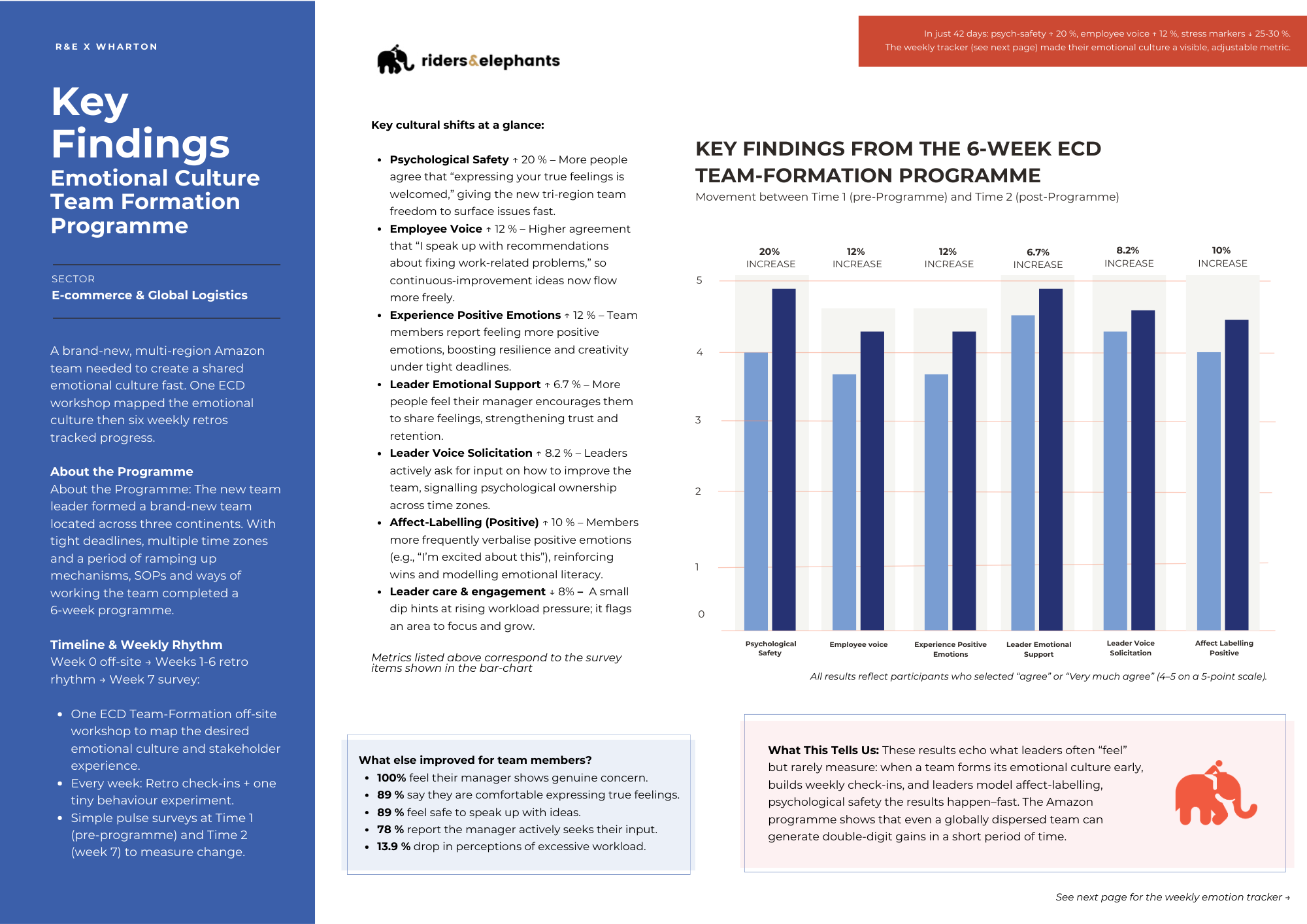
Separately, Professor Michael Parke of The Wharton School ran an independent survey. Wharton measured the outcomes rather than the weekly emotion data, and there psychological safety improved most.
"Partnering with Wharton gave it credibility, and it gave us valuable data. Emotions are data. They're telling us something."
She was honest about what didn't improve
The most trustworthy part of Susannah's story was that she did not only show the wins. Through a heavy delivery period, leader care dipped from a perfect score, engagement softened, and burnout ticked up slightly. What rose was the team naming their emotions out loud, both the good and the hard, which is exactly the muscle a weekly emotional culture check-in trains. Progress that includes the dips is far more believable than a straight line up.
She even wrestled openly with whether she, as the manager, should name her own negative feelings in front of the team. She decided yes. Tailored, but honest, because a culture built on openness cannot have the leader opting out of it.
It stuck without her, and then it spread
The proof of a real ritual is what happens when the leader steps away. Susannah's weekly check-in kept running while she was out. The team leads it themselves now, taking turns, and she deliberately goes last so the space belongs to them. Then it spread. A direct report who was promoted to lead her own team opened it the same way, with an emotional culture workshop of her own.
Why this matters, and what you can do
Susannah's story is a rare, evidence-backed look at emotional culture built on purpose, inside one of the most fast-paced, data-driven environments there is. It is proof for the work so many of us are doing. The next time a leader or a client asks whether this actually works, this is the kind of independently measured evidence that says yes.
It is also the future we are building toward. Susannah measured one team. Across our community we are now gathering the same kind of evidence at scale through our Emotional Evidence Platform, so the case for emotional culture keeps getting stronger and more shareable.
If you want to start where Susannah started, pick up the Emotional Culture Deck and run one honest conversation about the feelings your team wants to grow and the ones it wants to starve. Then nest a two-minute check-in into a meeting you already hold, and keep it simple enough to survive without you.
This is what it looks like to rehumanise the way we work. On purpose, and with the evidence to back it.
