
Emotional Culture Lessons from an Elite Elephant Rider
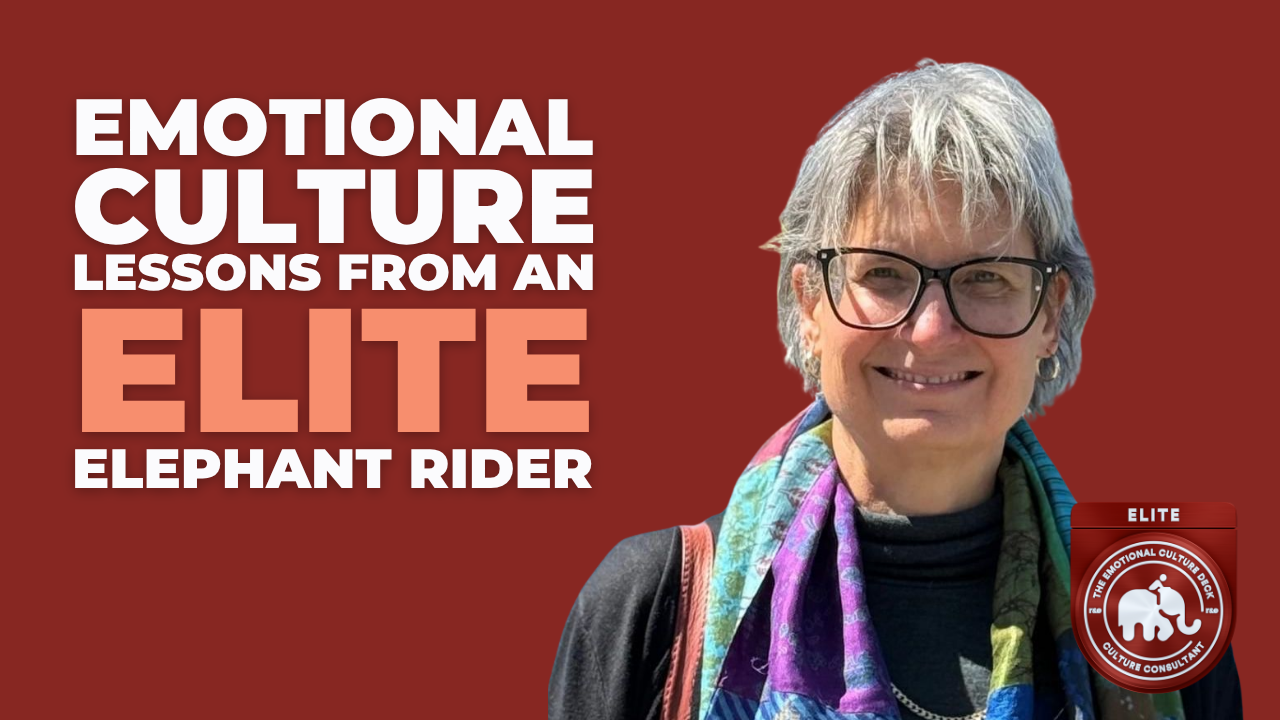
Cathy Sheppard has just become an Elite Elephant Rider, one of the highest badges on the ECD Certified Pathway. When we asked her to reflect on how she got here, she sent back something far better than an application. She sent back the thinking of someone who has spent twenty three years helping adults learn, and five of them weaving The ECD into that work until it became part of how she sees a room. We asked if we could publish it. She said yes. What follows is Cathy, in her own words.
Changes in how people respond to emotional culture conversations
I've noticed a huge shift in the way people talk about emotions over the years, and I think my perspective on this comes from a much longer journey than just the five or so years I've been using The ECD.
I've been facilitating learning with adults for around 23 years now. A lot of my early work was with Playcentre and teachers including leadership development, communication, facilitation skills, Te Tiriti o Waitangi, positive guidance and developing children's social competence. Emotions were always sitting underneath that work, because you can't really talk about relationships, behaviour or social competence without talking about emotions, even if we weren't always naming them as explicitly as I would now.
Since 2014 I've been facilitating Incredible Years programmes largely with early childhood teachers, helping them nurture children's emotional, social and academic competence. That's where I've seen one of the clearest changes.
When I first started that work, emotion talk and coaching was really limited. Emotion words being used usually came down to happy, sad and angry. There was much less understanding of the importance of helping children identify what they were feeling, or of self-regulation and the strategies children could learn to manage big emotions.
That's changed enormously. Now when we start talking about emotions, teachers are already telling us about breathing, calming strategies and the ways they're helping children recognise and name emotions. There are emotion pictures and language on the walls. We're much more often building on what is already there rather than introducing the whole idea from scratch.
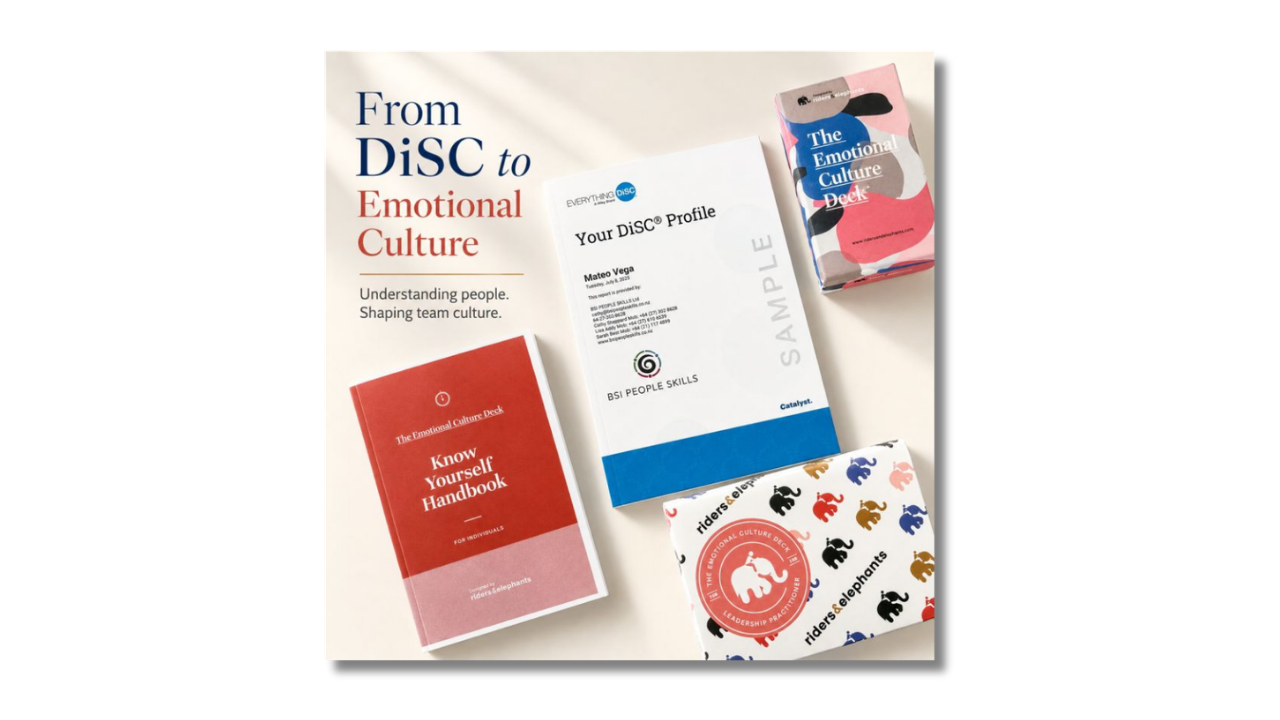
My own work has evolved alongside that. I attended my first DiSC workshop in 2005 and became certified in Everything DiSC in 2013. That gave me a very robust tool to help me understand people and why people respond so differently to each other. I could then use this in my work to help them build relationships, improve communication and work more effectively together. Emotion is inevitably part of that, because relationships are affected by how people feel, even when those feelings aren't being talked about.
The ECD has added another really powerful layer to that work, enabling the emotional part to be much more explicit. It gives people language for what's happening underneath the behaviour and gives me another way of helping them explore it.
I've seen a change in workplaces more broadly too. When I started BSI People Skills in 2013, talking about workplace culture sometimes felt like talking to a void! Leadership development was understood, but particularly here in New Zealand, there was far less recognition of culture as something organisations needed to deliberately shape. That's very different now. I've even watched quite a few organisations move from talking about HR to having People and Culture teams.
Within my ECD work, I still see a huge range in people's comfort with emotions. Some people engage immediately. Others are very task-focused or genuinely struggle with questions like what they need to feel for their success. I've learnt not to rush that or assume everyone will access the conversation in the same way.
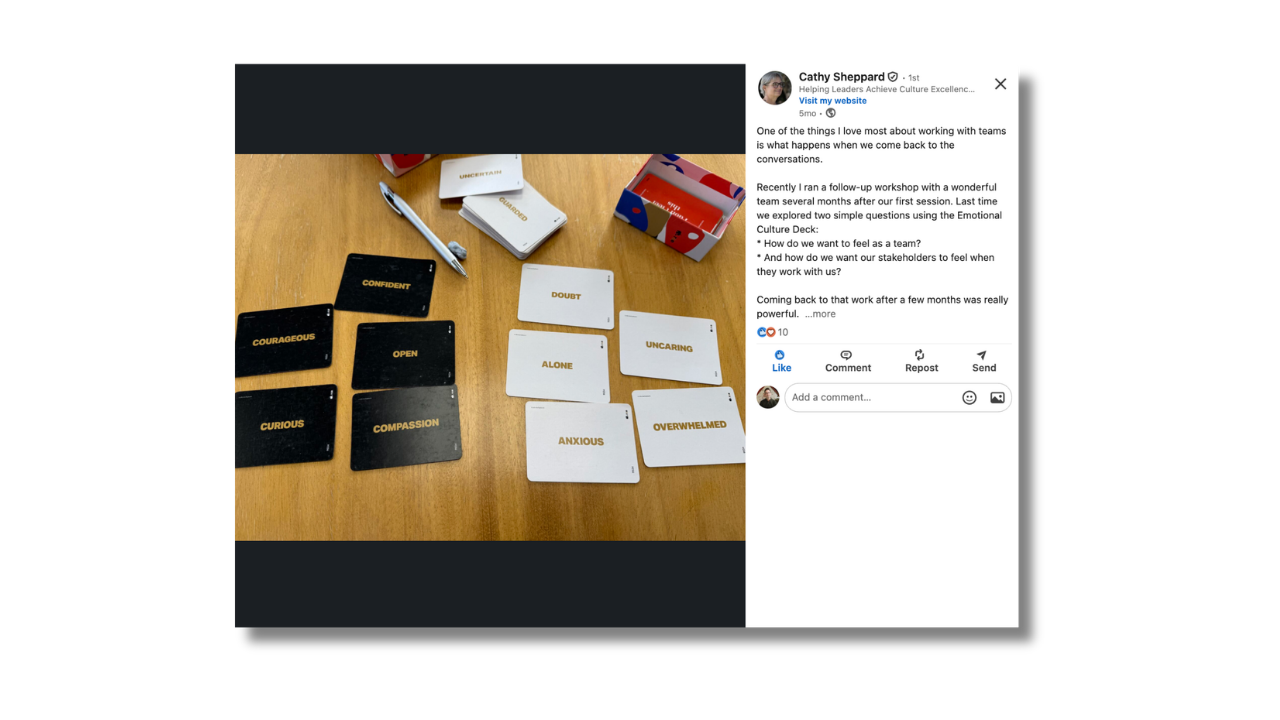
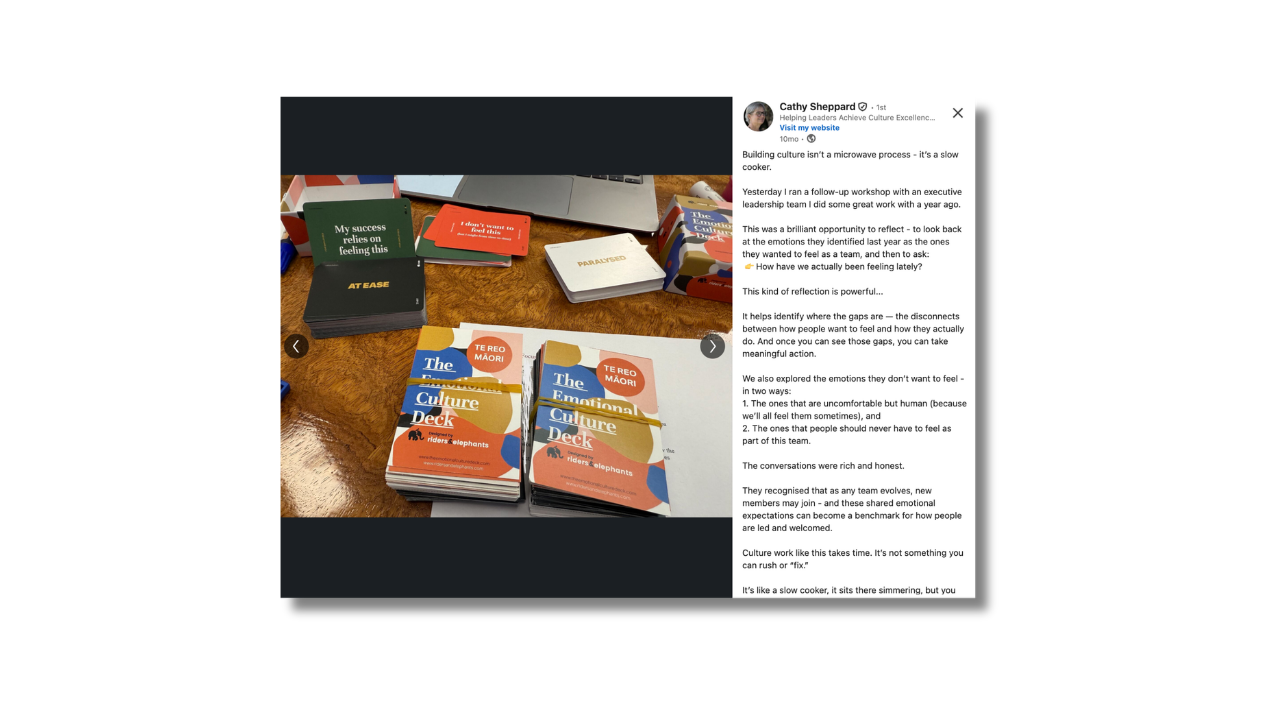
What I love seeing is what happens when people have the language and become familiar with it. Leaders I've worked with over time now use the cards easily to reflect on themselves, their people, difficult conversations, meetings, customers and stakeholders. Some are using their own decks with other people without me there. That's when it starts becoming part of how they lead rather than something we did together in a workshop.
For me, the biggest evolution has been making the role of emotions much more explicit. They're not separate from leadership, relationships, behaviour or culture. They're sitting underneath all of them.
And the question isn't just, "What are you feeling?" It's what happens next. Why are you feeling that? How do you want or need to feel? How might the other person want to feel? What actions will support that? What needs to change?
That's where The ECD has become such a valuable part of my kete. It gives people the language to explore something that has always been there, and then helps turn that understanding into action.
Most memorable moment or breakthrough with a leadership team
One of the most memorable workshops I've facilitated recently was with a team where relationships had become very fractured. There had been issues festering for a long time.
I'd spent 20 years working in a not-for-profit organisation myself, so I understand just how much people can be prepared to give because they care so deeply about the purpose of the organisation. I also know how much people can sometimes put up with because they believe so passionately in the work. I've lived that too. I'd been part of a fractured team myself, and then experienced that team being turned around to become one of the best teams I've ever been part of. That experience was actually part of what led me to start my business.
So I brought a lot of myself to this workshop.
Creating a safe space for people has been a key part of my facilitation practice for well over 20 years. I spent 12 years facilitating Te Tiriti o Waitangi workshops, where people were being asked to look at their own assumptions, beliefs and values and sometimes confront things that were really uncomfortable. I've learnt over many years that if you're asking people to go beyond what's happening in their head and look at what's happening in their heart, they need to feel safe enough to do that. Then you can provide the tools or content, and go on the journey together.
That was critical with this team.
We took time to create our way of working together, talk about what they loved about the organisation as well as the challenges of working there, giving people the space to talk.
I deliberately didn't start with The ECD. So much of what had happened in the team came back to communication, so Everything DiSC needed to come first. We spent a lot of time there, helping people understand where some of the misunderstandings had come from and what they could do differently.
Only towards the end of the day did I feel they were ready to go deeper with The ECD.
We started with the Weekly Retro. It's always amazing to see people having conversations they've never had before, sharing White Cards and realising that other people feel these things too. They actually said they felt lighter. Then we moved into Intention Setting and the Mini Know Yourself Handbook, which gave them another layer of self-awareness and, importantly, ownership. Knowing what you need gives you a path forward for action, rather than simply blaming somebody else for what you're not feeling.
At lunchtime, one of the team came up to me. She wanted to make sure I knew what a gift I'd given them in the way I'd created the space. She knew how important that was and also how rare it was to be able to create that space. That meant a lot.
But the moment I will never forget was at the end. We were talking about how they wanted to feel together going forward, and they pulled each other into this tight huddle, arms around each other.
I was left standing there in awe of them and the journey we'd been on that day.
For me, it reinforced something that sits at the heart of how I facilitate: bring the tools, create the space, trust the process and adapt everything else. The ECD is an incredibly powerful tool I've added to my kete, but the tool always needs to serve the people, not the other way around. Knowing when to bring it in, how far to take it, and what people need before they're ready for it is just as important as knowing the tool itself.
Expanding reach & influence with The ECD in the past year
Right from when I first trained in the ECD Emotional Culture Crafting Course, I was clear that I needed to integrate The ECD into everything I do. It's such a powerful tool.
Initially, that wasn't always smooth! I was learning the tools, experimenting with where they fitted and sometimes probably trying a little too hard to work out how to bring them in. It probably felt a bit disjointed for people. Five or so years later, it's completely different. The ECD is now just part of my kete and how I work. I don't have to think about whether I will use it anymore. It's more a question of when it will be useful, and which part of it will add the most value.
That means I'm using it in far more than ECD Culture workshops. It comes into my leadership coaching, leadership and team development, change, difficult conversations, customer and stakeholder work, business planning, reflection and review, and sometimes simply because something comes up in a conversation and I think, "We need to look at what emotions are behind this."
Over the past year, my influence has also expanded through the range of organisations I'm working with. A lot of my work is still one-off workshops, or a workshop with a follow-up, but I've been working with a wider range of new clients and organisations this year. That means The ECD is going into new workplaces and being experienced by people who may never have come across it otherwise.
I've also continued delivering the ECD Specialist Courses [certifying new ECD Practitioners], including Emotional Leadership and my first Emotional Change Strategy course. I really enjoy helping people understand not only how the different ECD tools work, but how they might actually use them in their own environments. Who could they use them with? What might get in the way? How could they adapt the process while still keeping the purpose of it?
One of the things I love most is seeing the influence spread without me as people feel empowered to have new conversations and try new things with their people. Leaders I've coached are now using their own decks and the different ECD tools in whatever way they need to improve the culture in their organisations. One leader received his deck before our first session using it and had already tried it with two different people before we met! Others are taking the Weekly Retro, Intention Setting and other conversations back into their teams and adapting them to what their people need.
For me, that's probably the most exciting kind of expansion. It's not just about how many workshops I run or how many people I personally work with. It's about leaders and people becoming confident enough to use the tools themselves and make them part of the way they lead and shape culture.
When someone I've worked with uses The ECD to create a conversation, change a meeting, support a person, strengthen a team or improve something in their organisation's culture, the impact has gone well beyond the work I did with them. That's what I want to see more of. People matter!
He aha te mea nui o te ao? He tangata, he tangata, he tangata.
A key insight shaping how I craft emotional culture
One thing I've really noticed is just how many different ways the beautiful questions can be tweaked to get completely different outcomes.
"How do they feel?", "What do they want to feel?" and "What do you want them to feel?" sound very similar, but they're actually three totally different questions.
Both the first two get you thinking about the other person. The first gets you thinking about how they are feeling right now, the second about the other person and what matters to them. The third gets you thinking about the impact you want to have on them. There are so many other subtle ways the questions can be changed depending on what's going on.
What I've noticed in my 1:1 work is how naturally and intuitively I'm doing this now. I think that comes from how deliberately I've integrated The ECD into my work, and from using the tools so often, with so many different people and situations.
A leader brings a challenge, and I'm refining the questions in the moment depending on what they need to explore.
People are remarkably complex. There isn't one question that's going to unlock every situation. Being able to change the question slightly can give a leader a completely different perspective and sometimes exactly the insight they need at that time.
I think that's been one of the biggest developments for me with The ECD. I know the beautiful questions well enough now that I'm not thinking about which question comes next. I'm not even consciously thinking which question to ask anymore. I'm listening to the person, thinking about what might be sitting underneath the challenge they're facing, and the question just comes out from there.
Elevating my practice through working with others
One of the things that's added to my practice recently was doing the Workplace Rituals Deck certification with Lotty Roberts and Lorissa Garcia.wrokpalce rituals deck
I really enjoyed being able to look more deeply at rituals and what makes them actually work, rather than just coming up with a good idea and hoping it sticks. I've already brought some of that thinking into my own work, including using the Workplace Rituals Deck in the Emotional Change Strategy certification I ran recently. It fitted beautifully with the ECD work around creating rituals that support the emotions and behaviours people are wanting. I loved the examples that helped with ideas and the deliberate link to the purpose of that particular ritual as it's being crafted. Being able to set the trigger, the action to happen, the person responsible and the reward people will get means that any ritual becomes much more intentional too.
I think that's one of the things I value about learning with other practitioners. They bring different thinking, different experiences and different ways of using the tools, and I can then work out what fits with the work I already do, especially since I work with such a wide range of people!
Co-facilitation is also something I'm very used to. I've done a lot of it through my Incredible Years work and over the years through Playcentre. I love the learning that comes from having two experienced facilitators in the room. You notice different things, bring different strengths and learn from each other as you go.
I'd really like to take that into my ECD work more. Lotty and I have talked about running a ECD Specialist Courses together, and I'd love to make that happen. I think bringing both of our experience into the room would add another layer for the participants, and for both of us as practitioners too, as well as giving the participants a wider range of people there on the day.
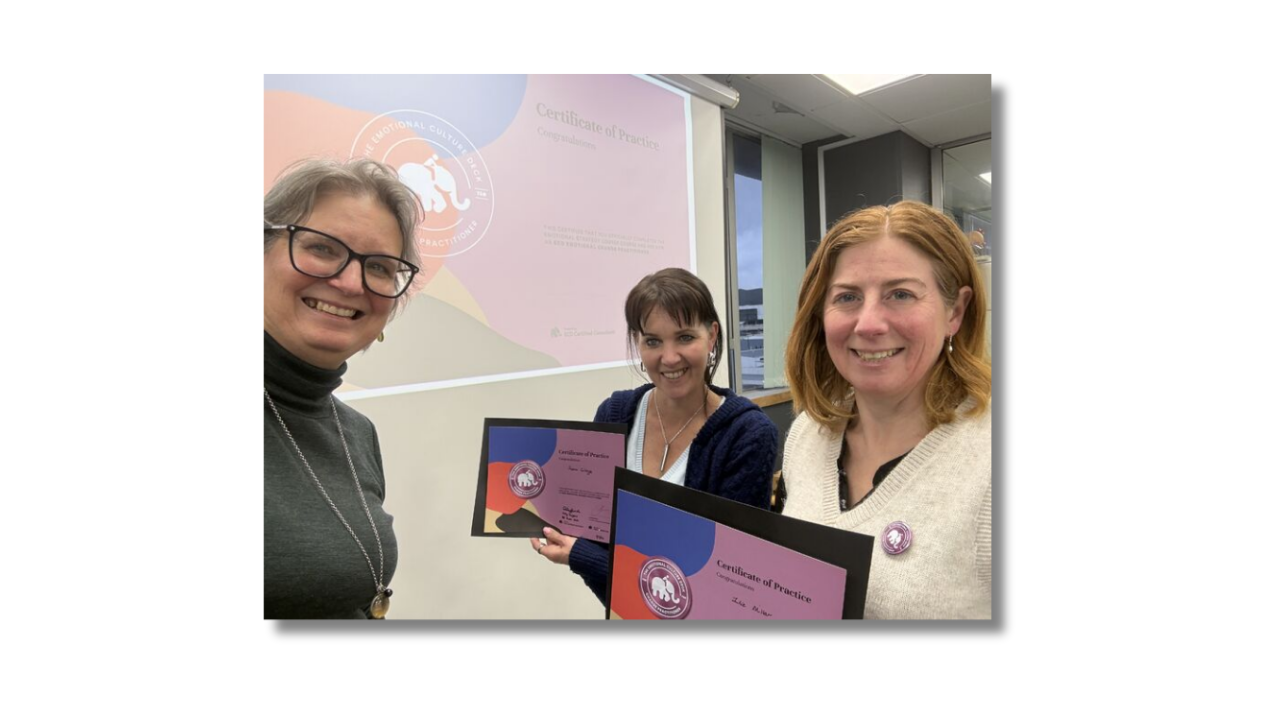
Growing other people who work in this space. Two new Certified ECD Practitioners trained by Cathy
The next challenge on the journey toward ECD mastery.
I think for where I am at now in my career, my biggest next step is continuing to grow my thought leadership.
I've spent a lot of years doing the work, working with leaders and teams, trying things, learning, reflecting, adapting and building up a really deep understanding of what helps people and cultures grow. I want to keep getting better at putting that thinking into words, models and ideas that can travel further than the people I'm personally working with.
Emotional culture is an important part of that. The ECD is now deeply integrated into the wider Culture Excellence work I do, alongside DiSC, Five Behaviors, Incredible Years and the other tools in my kete. I want to keep exploring and sharing what I've learnt about how emotions, behaviour, leadership and culture all fit together.
I'd also love to keep growing other people who work in this space. One of the things I've loved most over the years has been developing facilitators and leaders so that they can work confidently and intuitively with the people in front of them, rather than just following a process. That has been a big part of my work before, and I'd love for it to become a bigger part again in the future.
For me, that's where the ripple effect really comes in.
I've always had this image in my head of throwing stones into still water. One stone creates ripples, but I've never wanted to throw just one stone. I want to throw handfuls of stones, and keep throwing them.
If I can share what I've learnt, grow leaders and facilitators who then influence other people, and help those people create better leaders, teams and workplaces in turn, the impact can travel so much further than I ever could on my own.
That's what I want the next stage to be about: continuing to deepen my own practice, sharing what I know more widely, growing the capability of others, and creating more and more ripples.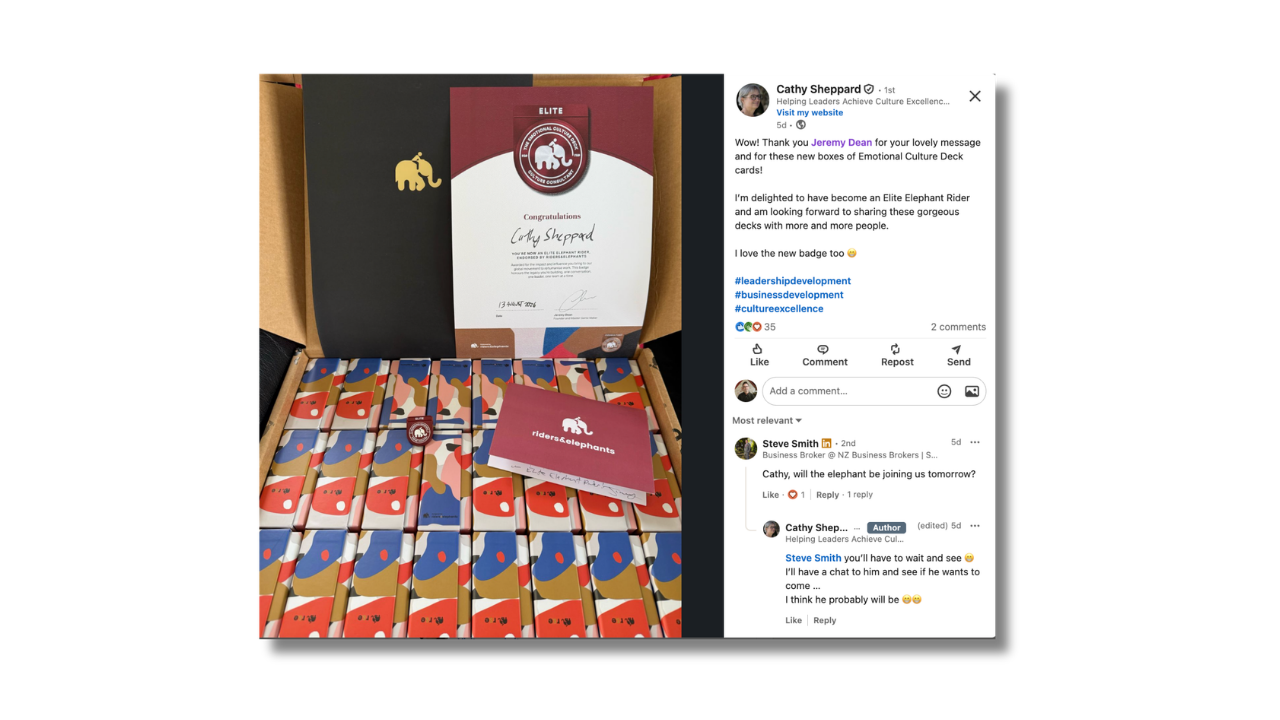
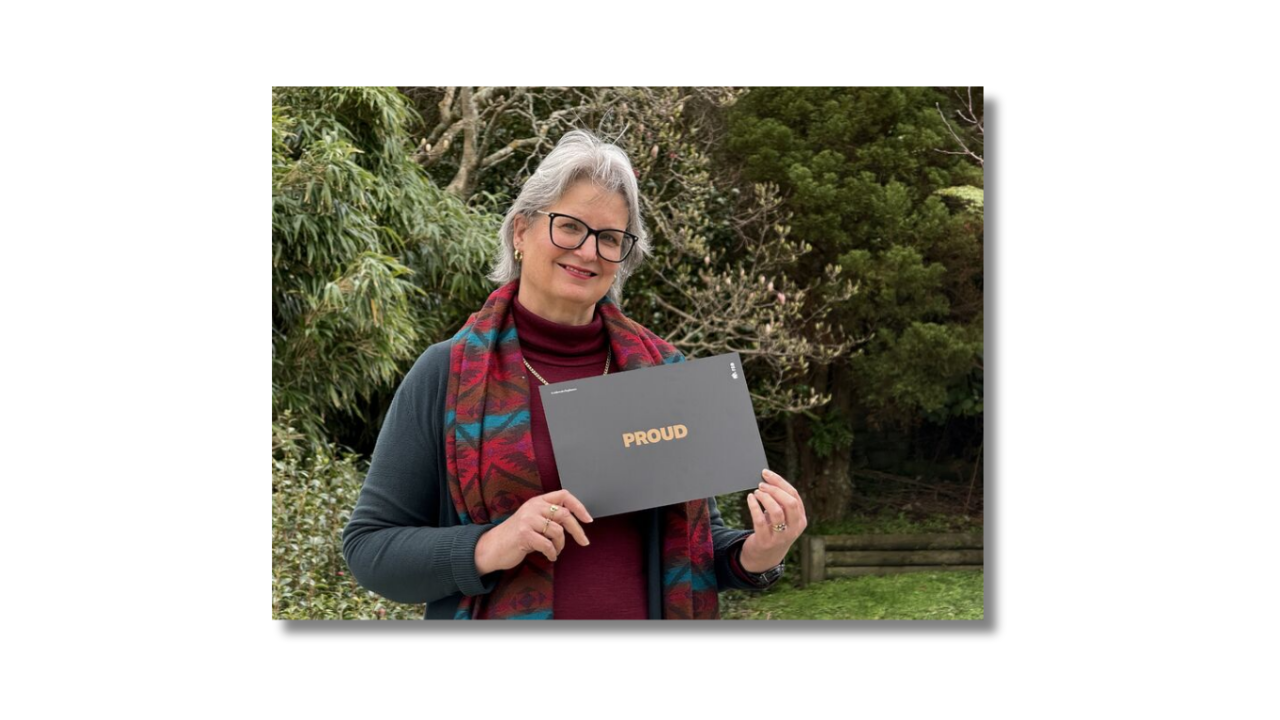
More stones, ready to throw. Cathy's Elite certificate and a box of decks headed out into the world.
If her story has you wondering where your own practice could go next, the ECD Certified Pathway is where that starts. Behind every badge is a leader who is rehumanising the workplace, one f-word conversation at a time.
Cathy is the Founder and CEO of BSI People Skills. You can follow her here on LinkedIn.
And if you're based in Wellington, New Zealand or working with teams anywhere, and would like someone to bring emotional culture conversations into your workplace, to drive culture and performance across your organisation, to work with your leaders, to help you navigate change, or to shape how you engage with your stakeholders, reach out to Cathy for a chat.
