
From Anec-data to Evidence (and What We Measure Now)
by Jeremy Dean, R&E Founder
I met someone for coffee recently. He’s spent a decade building digital products and is now behind one that one million people use. I’d been told he was worth talking to. He was.
He said something that stopped me. “You have anec-data evidence.”
He paused. “But you’re building real-data evidence now.”
It’s the thing most founders in the human space are running on. The story from the workshop that made everyone cry. The leader who said it changed everything. The team that came back six months later to say they were still using the language.
Real. Meaningful & True. And completely impossible to put in front of a CFO.
I’ve been building riders&elephants for almost a decade. I created The Emotional Culture Deck. We’ve certified 2,000+ practitioners across 45 countries so far. People within our community deliver emotional culture conversations, workshops & programmes inside governments, hospitals, startups, and multinationals on almost every continent.
And for almost all of that time, our evidence was anec-data.
Not because we were lazy. Not because we didn’t believe in the work and the impact. But because nobody had built the infrastructure to capture what was actually happening inside those rooms. The emotion that shifted. The safety that grew. The voice that finally got heard.
We knew it was real. We felt it every time. But feeling something and proving something are two different things.
But will it even matter?
There’s a psychological phenomenon called the backfire effect. It says that if someone doesn’t already believe what you believe, presenting them with evidence doesn’t change their mind. It actually reinforces their existing position. Think about flat earthers. No amount of satellite imagery will shift them.
I learned about this early on when I was designing The ECD and it has haunted me ever since because it raises a question I’ve never been able to fully answer: if a leader doesn’t believe emotions matter at work, will showing them data that says otherwise actually change anything? Or will they just dig in harder?
I’ve sat with that question for years. It’s part of the reason I felt stuck about building an evidence platform in the first place. Will it even matter? Will it change people’s minds?
And here’s where I’ve landed, at least for now. Maybe we can’t convince everyone. And maybe it isn’t our job to convince anyone. But if this platform helps nudge that one leader who already wants to believe but needs the justification or evidence to convince the person who really influences their team or their budget... if it helps convert even 10% more people or leaders or teams to have these conversations about how they feel at work... then it matters. And it will make a difference.
So the question becomes: what proof do we need to collect & show?
The hardest part of building this
One of the hardest things about building the Emotional Evidence Platform so far has been deciding what to actually measure.
Not because there aren’t enough things to track. There are too many. The real challenge is how we measure something as deeply human as emotional culture without turning it into another engagement survey? Without reducing it to a score out of ten? Without becoming the very thing we’ve spent a decade fighting against. Death by diagnostic.
The ECD has always been interpretivist at its core. It surfaces meaning. It invites stories. It holds space. The cards in people’s hands, the silence before someone speaks, the conversation that follows. That’s the work.
But leaders want evidence. They want to know if the work moved anything. They want something they can put in a board presentation. And I understand why, because without evidence this work stays in the “nice to have” category forever and that’s a problem I feel deeply frustrated by because I know what this work does when it’s done well and I’ve watched it change teams and organisations for ten years without being able to prove it in the language that decision makers trust.
So we have to figure out what to measure. And more importantly, what not to measure.
What we’re not measuring
We’re not measuring the emotions or emotional culture itself. Yet. That will come next.
Which might sound strange coming from a company that helps organisations and teams design, manage & influence their emotional cultures.
But the emotional culture is the emotions a team chooses to put at the heart of how they work together. That’s what our emotional culture system, the conversations and the deck, helps surface. The emotions they want more of, less of. We can’t reduce that to a bar chart and expect the people who decide if we do more of this important work or not to understand that or believe or invest in that alone.
What we are measuring is whether things shifted after doing the emotional culture work. Did people build new skills? Did the team environment change? Did it affect how people show up at work?
That’s a different thing. And getting clear on that distinction took longer than I expected.
Three categories of emotional evidence
We’ve landed on three measurement categories, plus a satisfaction check.
Here’s how I think about them:
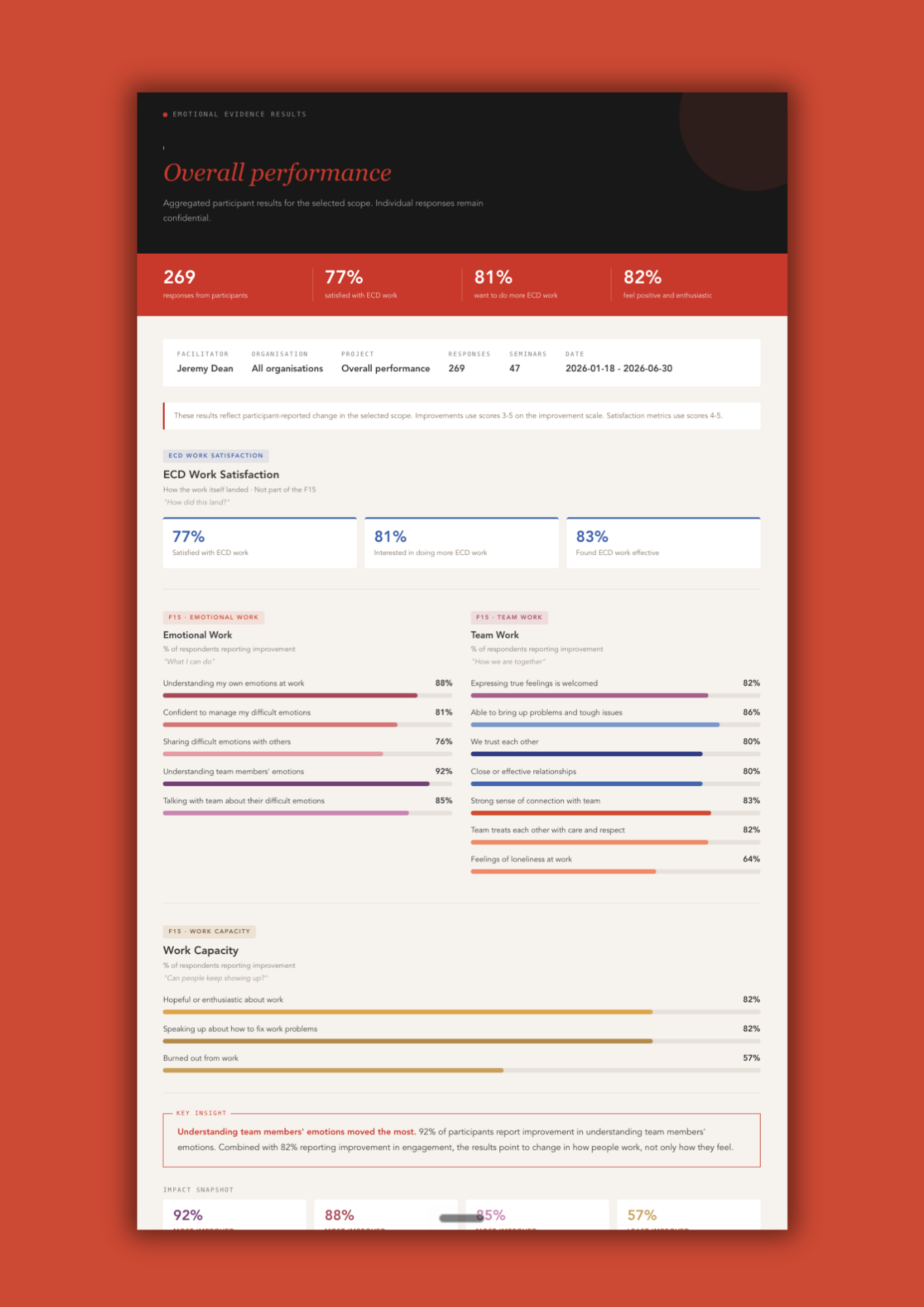
Emotional Work is about the skills you’ve built. Can you understand your own emotions at work? Can you manage them? Can you talk about them? Can you read what’s happening for your team members? This is the personal capability layer. It’s the “what I can do” part.
Team Work is about how the team operates together. Do people feel safe to express their true feelings? Can they raise tough issues? Do they trust each other? Are their relationships strong? Do they feel connected or lonely? This is the relational foundation. The conditions that support emotional culture even if they’re not the culture itself.
Work Capacity is the one that goes in the board pack. Engagement. Speaking up. Burnout. These are the measures that executives already care about and they’re the proof that emotional culture work isn’t just “fluffy.” It’s the sustainable performance layer. Because sustainable performance is always emotional, whether leaders want to admit that or not.
Then we ask three satisfaction questions – was the emotional culture work effective, were you satisfied with it, do you want more of it. Those show up as callout stats, not in the bar charts.
Why these three and not something else
The categories map to different audiences. Facilitators and coaches care most about Emotional Work because it tells them whether the skills landed. Managers and team leaders care about Team Work because it tells them whether the environment is shifting. And the C-suite cares about Work Capacity because it tells them whether any of this translated into the outcomes they’re already tracking.
But here’s the thing that matters to me. The Work Capacity numbers only make sense when you understand the Emotional Work & Team Work that drove them. A CEO can look at a burnout number all day long. But without understanding what’s happening in the emotional skills and team dynamics underneath it, they’ll never know what to do about it.
That’s the gap we’re filling. Not another diagnostic or weekly or pulse engagement tool. Not another quadrant. An evidence layer that sits alongside the conversations we create and tracks whether those conversations are making a real difference over time.
What we still need to build
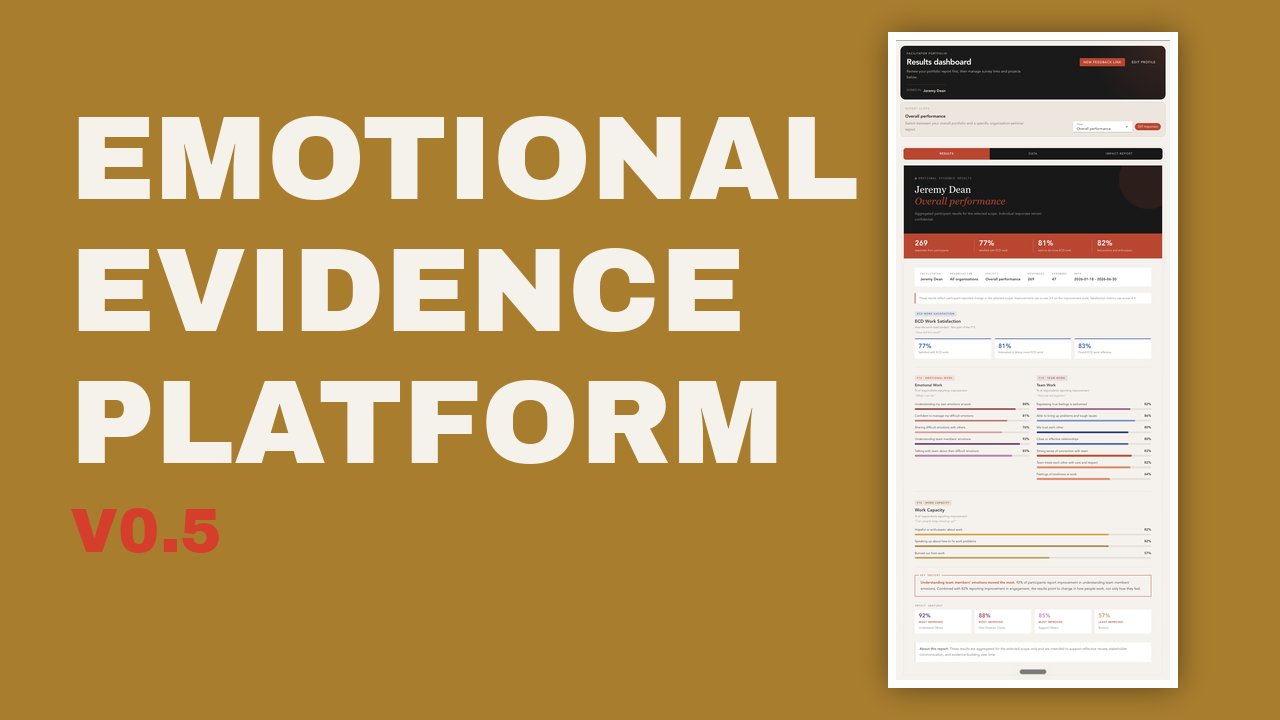
Right now the v0.5 platform measures self-reported improvement after doing ECD work. That’s powerful and it’s producing real results with our beta testers.
But the bigger vision is an emotional culture tracker that captures the emotions teams choose over time, the ones they want to feel more of and less of, and tracks how those shift. That’s the piece that would connect the interpretive heart of the ECD to the measurement layer. The cards people pick becoming data points that tell a story over time. I see Elephant Riders in our communirty doing this across the world, using other paltforms to do this becuase we can’t offer them that yet outselves. I now it matters to them and helps them understand and an emotional level what’s moving as they deliver their programmes.
We’re not there yet. That’s a future milestone. But it’s the thing I’m excited about and also the thing that scares me most, because it means taking the most human, interpretive part of what we do and finding a way to make it visible without killing what makes it special.
The tension continues.
And next week…
We’re inviting the next group of Elephant Riders in our community to join the platform and begin collecting the real emotional evidence data, to help them prove their work moves what matters, makes a real impact, and changes the story that gets told inside workplaces across the world that emotions are fluffy.
Because we know, and are now proving, that emotions are hard... and that behind every data point is a human with emotions, that drive how they perform.
