
Someone asked me recently what makes me confident that the our platform won't get left behind. What protects us from the competition. That it won't become another tool that had its moment and then got swallowed by the next wave of AI or whatever comes after AI.
It's a fair question. Especially right now, when every second founder & company seems to be building something on top of the latest AI technology. And some of it is. But most of it is building for the wave. And waves eventually dissipate.
I've been thinking about this a lot and I want to share where I've landed because it connects to something bigger than our platform we’re building. It connects to why riders&elephants exists at all.
It comes down to a fundamental human truth.
It's tempting to build things that ride the wave of the latest trend or technology. A new AI model drops, someone wraps a product around it, they get funding, they scale, and then eighteen months later the model changes or something better arrives and the product is scrambling to find its reason to exist.
This has always happened. It happened with social media tools, with blockchain startups, with the first wave of chatbots. It's happening now with AI. And it will happen with whatever comes next.
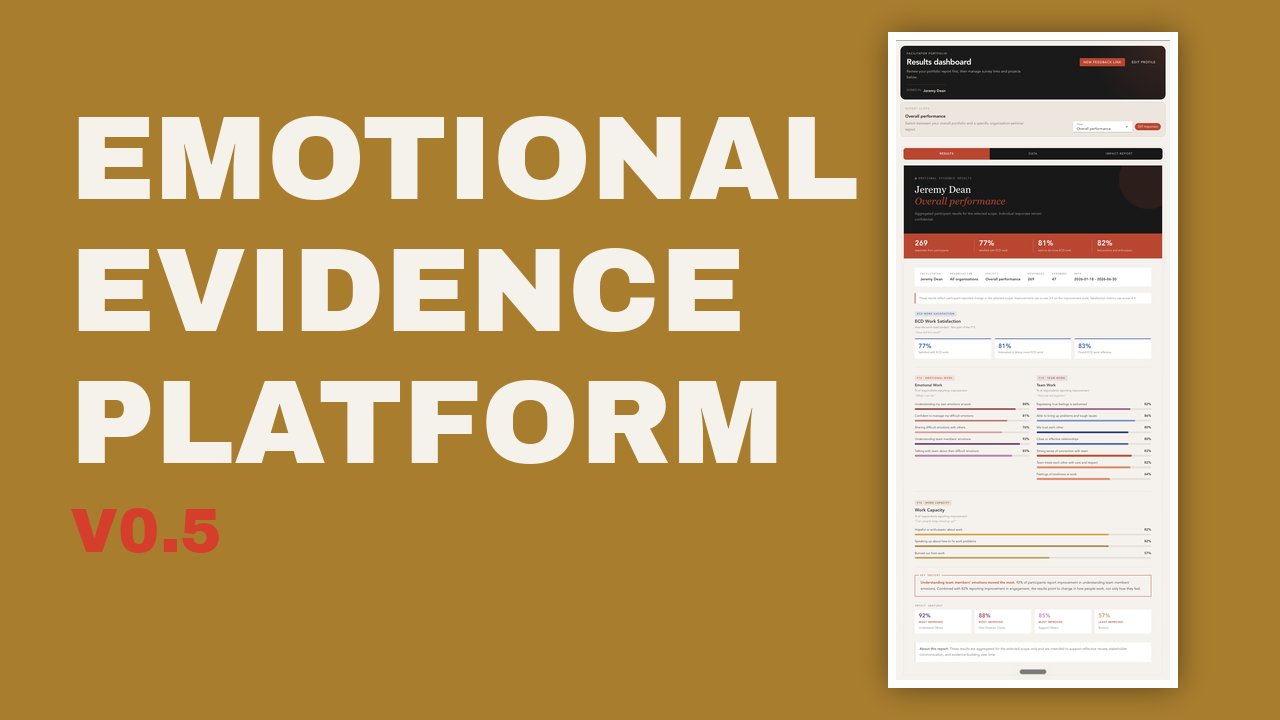
I'm not saying technology doesn't matter. It does. The Emotional Evidence Platform is built on modern technology and it will keep evolving as the tech evolves. That's the delivery mechanism. That's the vehicle.
But the vehicle isn't the thing. The destination is the thing. And the destination has to be somewhere that doesn't move.
What doesn't change? Emotions drive human behaviour.
That's it. That's the fundamental human truth underneath everything we build.
It's not a trend. It's not a framework someone invented in 2015 that might get replaced by a better framework in 2027. It's not a technology that has a shelf life. It's biology & psychology. It's how human beings have operated for as long as we've been human beings.
The amygdala doesn't care about your tech stack.
Fear, trust, belonging, frustration, hope, anxiety, joy, loneliness. These are the forces that shape how people show up at work, how they make decisions, how they treat each other, whether they speak up or stay silent, whether they burn out or thrive. And they've been doing this for hundreds of thousands of years, long before anyone invented an engagement survey or a culture diagnostic or a performance management platform.
If you build on a technology, you're one innovation cycle away from irrelevance. If you build on a fundamental human truth, you're building on something that will take Darwinian evolution to change. And Darwinian evolution operates on a timeline that makes product roadmaps look like Post-it notes.
I don’t want R&E to become a tech company that happens to care about emotions. We're a company built on a fundamental human truth that will happen to use technology.
That distinction matters.
The Emotional Culture Deck works because emotions drive behaviour and people want to express how they feel but don’t know how. The conversations it creates work because humans are wired to connect and want autonomy is how much they share. The platform we're building works because it captures evidence of something real, something that has always been real, something that will always be real.
When the technology changes, and it will, we update the delivery mechanism. We will need to dopt better tools. We will have to rebuild the interface. We will integrate whatever AI or data science or whatever-comes-next can offer. But the thing underneath stays the same.
Emotions drive behaviour. And how we behave drives performance. That truth doesn't have a version number.
I think about this every time I feel the pull to chase something shiny. A new feature someone else has built. A competitor who raised funding. An AI tool that analysis affective sentiment (which we don’t do and will be the topic of another post soon. Although I want to makw it simple & beautiful - the conversations we create and how we measure them, it’s the messiness of actual human emotions & conversation that we’re designing and that come with friction & tension that makes them real. We don’t speed that up. We slow you down. Intentionally.
So the companies that build on technologies can move fast. They can scale. They can look impressive in a pitch deck. But they're always one cycle away from having to reinvent themselves.
The companies that build on fundamental human truths move slower sometimes. They're messier. They wrestle with harder questions, like how do you move & measure something as deeply human as emotions without destroying what makes it human in the first place. But they don't get swept away when the tide turns because the thing they're standing on isn't going anywhere.
That's what I want to build. Something on a foundation that doesn't shift.
Emotions drive human behaviour. We move & measure the emotions that drive performance. The technology will change around us. That fundamental human truth won't.
And if you're building something yourself, whether it's a coaching practice or a consulting business or a product or a team, I think the same question is worth asking too. What's the human truth underneath what you're delivering or building? And will it still be true in fifty years?
If the answer is yes, you're building on something that will be harder to disrupt.
Jeremy Dean, Founder of riders&elephants (a company that moves & measures the emotions that drive performance) writing about emotions & entrepreneurship.
